
Your Next Customer Will Send an Agent
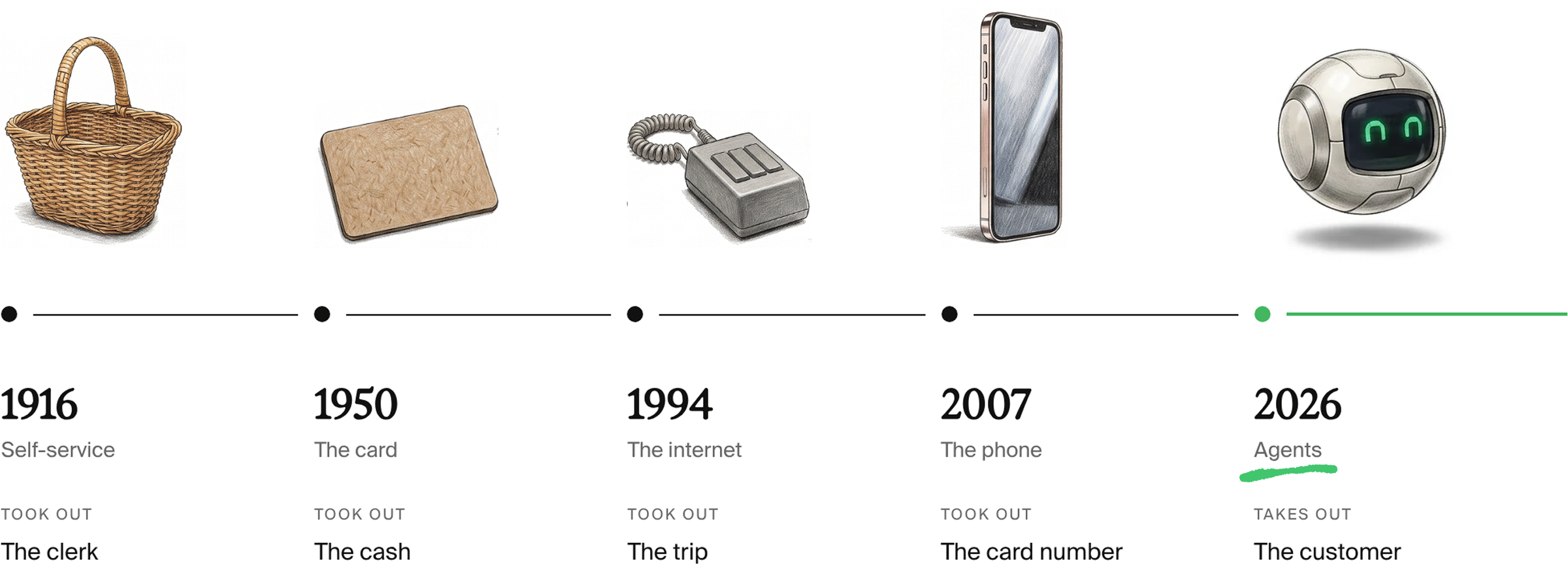
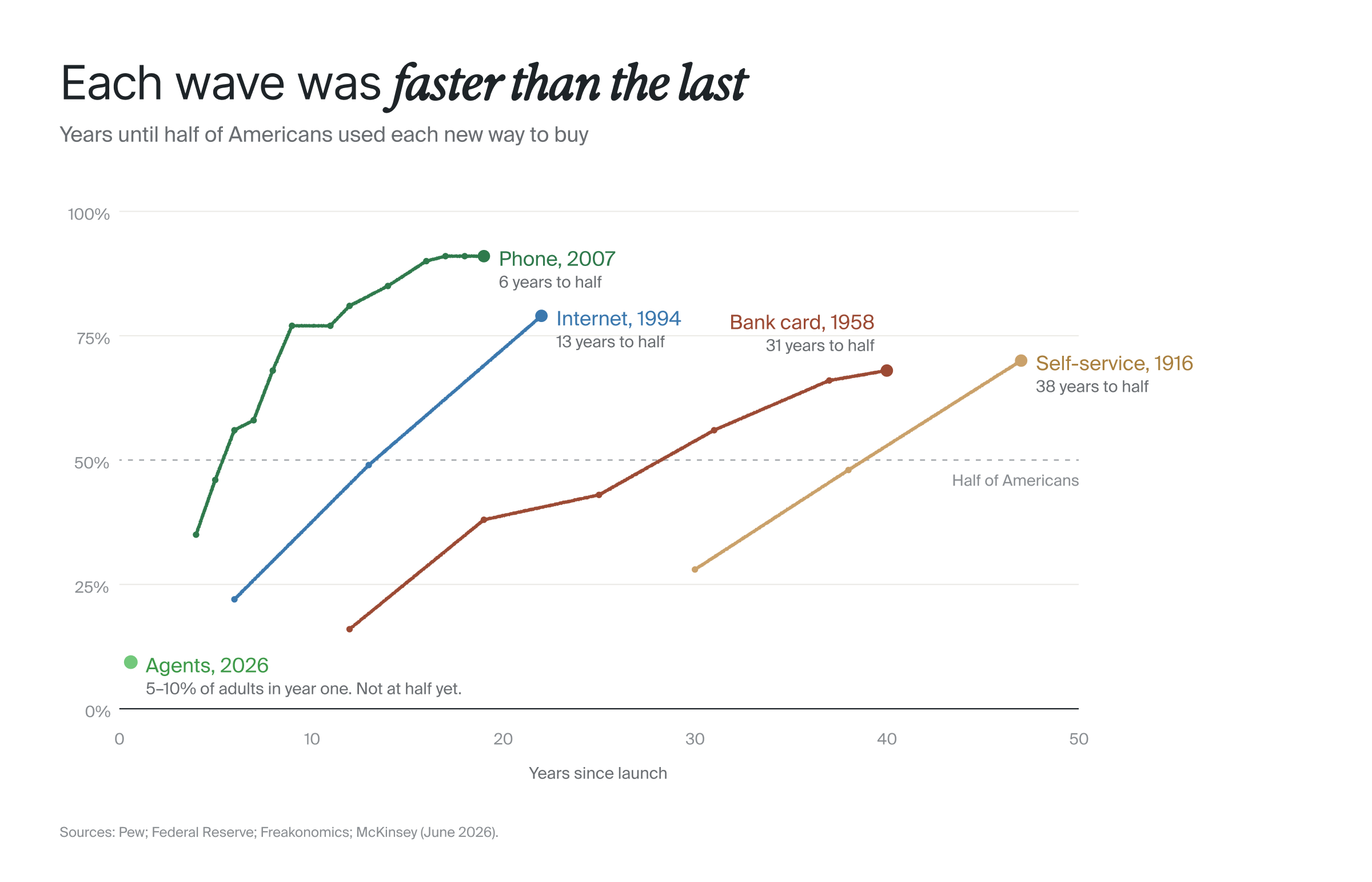
Shopping has had four mega waves in 110 years. Self-service arrived in 1916, the card in 1950, the internet in 1994 and the phone in 2007. Each one took one more person or step out of the purchase: the clerk, the cash, the trip to the store, the card number.
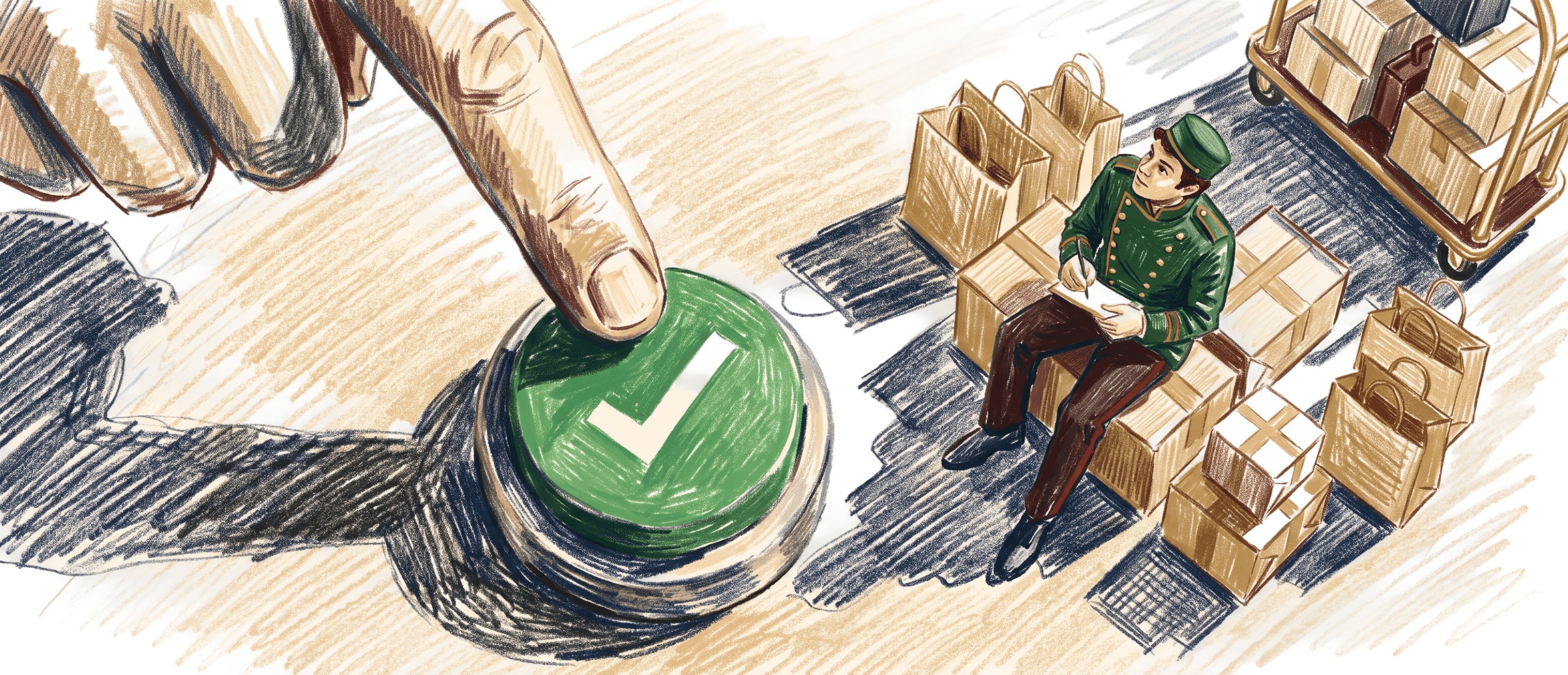
The fifth wave started this fall. It takes out the customer.
AI agents can now find what you sell, sign in to your store and pay for it, while the person who wanted it is somewhere else. So every brand now has two kinds of customers: the ones who come in, and the ones who send an agent. Most stores are only built for the first kind.
On October 21, Stripe put its wallet inside Claude Duet, Anthropic’s new agent. You type “order more shipping labels, same as last time.” Duet finds them, shows you the price and waits. You say yes, and it pays with a card number made for that one purchase at that one store. Then the number stops working.
Stripe isn’t alone. Between September 8 and October 28, the rest of the market moved too.
Shopify opened Shop Pay to agents, first at Shopify stores and then at stores off Shopify too.
Walmart announced a profile for each agent a customer sends, with its own spending limit.
Meta’s Muse agent passed 10 million users in about six weeks, and shopping is one of the top things people do with it.
Google said its agent comes to the Gemini app, and its billion users, before the end of 2026.
The history of shopping shows how each of these shifts played out, who won them, and what that means for the one starting now.
Five waves
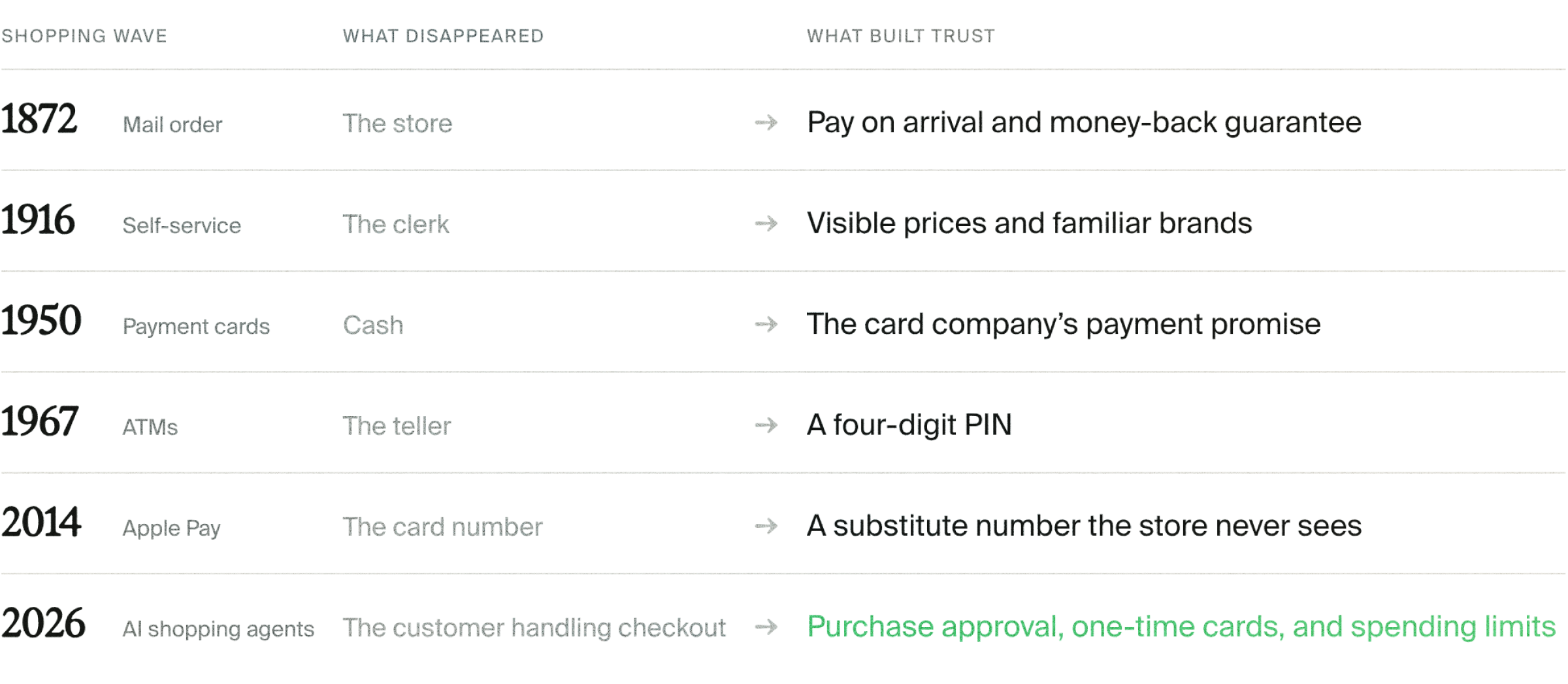
Each wave raised the same two questions. What left the purchase? And what took over their job of being trusted?
Before the waves: 1872.
The first time Americans bought from a business they couldn't see, newspapers called it a scam. Aaron Montgomery Ward mailed his first catalog in August 1872: one sheet, 163 items, for farm families far from a decent store. He had no physical shop, only a post-office box. In November 1873 the Chicago Tribune warned readers off his "swindling firm." A few weeks later the paper apologized, and Ward printed the apology on his next flyer. What won people over was a promise: pay when it arrives, and send it back if you don't like it. Before long, the catalog promised "satisfaction guaranteed or your money back."
1916: Self-service takes out the clerk.
Before 1916, you handed your list to a clerk, who fetched everything from shelves only the they could reach. That September, Clarence Saunders opened Piggly Wiggly in Memphis and handed shoppers their own shopping basket. By 1922 there were about 1,300 Piggly Wiggly stores. He wasn't the first; small "grocerterias" were already running in Walla Walla, Tucson and Riverside. The clerk's role as the one you trusted passed to things shoppers could check for themselves: a printed price on every item, and brands they knew.
1950: The card takes out the cash.
The legend says Frank McNamara forgot his wallet at dinner and started Diners Club so it would never happen again. The company's first press agent later wrote that he made the story up. What actually happened is that in February 1950, Diners Club gave members a cardboard card and promised restaurants it would pay their bills, for a cut of each one. Restaurants now trusted a company instead of the person eating. McNamara sold his stake in 1953 for $200,000, betting that Americans would never get comfortable with credit.
The people in the middle kept leaving. In 1958 Bank of America mailed 60,000 credit cards nobody had asked for to homes in Fresno, so no loan officer decided who got one. Delinquencies passed 20%, and the man who ran the program quit within two years. It became Visa. In 1967 Barclays opened the first cash machine, in Enfield, and the teller left too. The PIN took over the teller's job of knowing who you were. It has four digits because the inventor's wife said six was too many to remember.
1994: The internet takes out the trip.
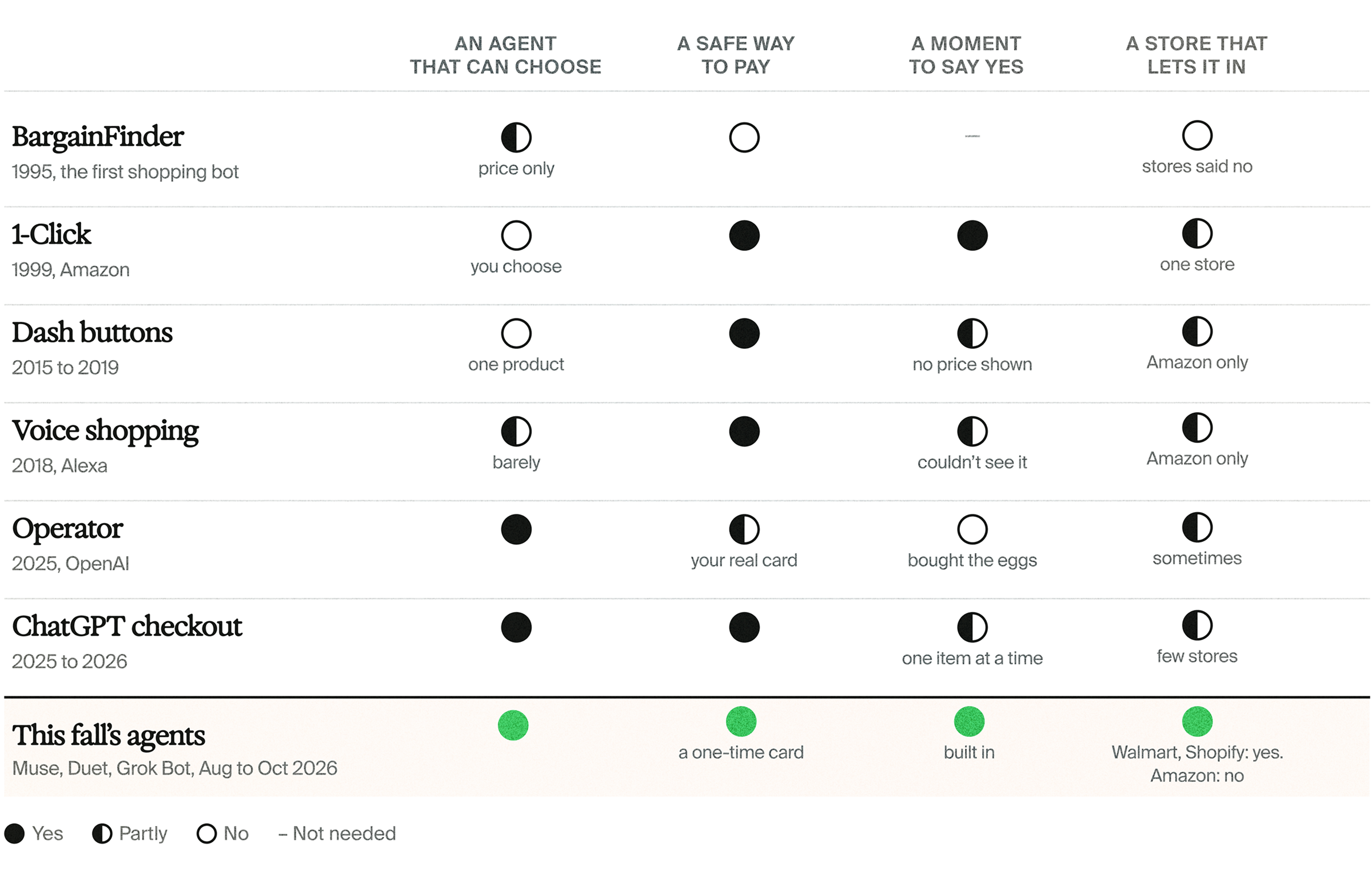
There was a preview in 1984, when Jane Snowball, 72, ordered margarine, cornflakes and eggs from her local Tesco with a TV remote, then paid cash at the door. The real start came in August 1994 with the first secure purchase was made on the web. A Sting CD for $12.48 plus shipping. A secure connection let people type a card number into a store they'd never set foot in. In 1999 Amazon patented 1-Click, which saved your card and address so buying again only took one click, and Apple licensed it the next year. The first shopping bot appeared early, too. In 1995 BargainFinder asked online CD stores for their prices, and several blocked it.
2007: The phone takes out the card number.
The iPhone put a store in every pocket. In 2014 Apple Pay went further: the store never sees your card number, only a stand-in made for your phone. It's the same idea as the one-time card Duet uses.
Not every shortcut in this wave stuck. Amazon's Dash buttons reordered detergent with one press, and orders grew 650% in a year. But a German court ruled that the button never showed the price, and Amazon retired Dash in 2019. Voice was supposed to be next. A 2018 forecast said US and UK shoppers would spend $40 billion by voice by 2022. That year, about 2% of Alexa owners had bought anything with it.
The Fifth Wave: Agents take the Customer out of the store
The first agents arrived before they were ready. In February 2025, a Washington Post columnist asked OpenAI's Operator to find the cheapest dozen eggs. It bought them, for $31.43, without asking. ChatGPT's buy button came in September 2025, and OpenAI scaled it back in March 2026. Walmart shoppers using it didn't want to buy one item at a time. They were afraid of getting "five boxes when they actually just want it all in one," in the words of Walmart's Daniel Danker.
Every earlier attempt was missing at least one of four things: an agent that could choose well, a safe way to pay, a moment for the person to say yes, and a store willing to let the agent in. This fall, all four arrived together. Muse launched on September 8 with Stripe's Link, and the person approves every purchase. In October came Claude Duet, Shop Pay at stores off Shopify and Walmart's plan for agent profiles.
What the waves teach
Suspicion comes first.
The Tribune went after Ward because he was only a post-office box. Restaurants turned Diners Club down for months, and its first customers thought there had to be a catch. CD stores blocked BargainFinder. In September 2026, Amazon blocked Meta's Muse, saying Meta never told it and the agent doesn't identify itself as one. It's the same complaint that the Tribune had, 153 years later. They're opening up discussions again, but there are still open questions on ads, search results, and which relationship gets the credit.
Each wave needed something new to carry the trust.
Every person who left the purchase took some trust with them. The clerk knew your order, and the teller knew your face. Each wave stuck only when something replaced them: Ward's guarantee, the printed price, the card company's promise, the PIN, the stand-in card number. The agent wave is building its own versions of trust now. The person approves each purchase, the agent pays with a card that works once, and at Walmart the customer can cap what an agent spends. These are this wave's money-back guarantee.
The people move behind the wall.
The Automat looked like a machine. At its peak it served 800,000 people a day, and behind the wall, workers slid fresh pie into each slot as it emptied. Smithsonian magazine put it plainly: the Automats were heavily staffed. When an agent buys from you, your people don't go away either. They handle the return, the wrong size and the order that showed up twice. The customer just never sees them.
The first versions fail, and nobody buys what they can't see.
The Fresno Drop, Piggly Wiggly's founder, Dash, voice shopping and ChatGPT's first checkout all stumbled, mostly because shoppers had no new reason to trust them yet. Voice failed because people couldn't see what they were buying. Dash lost in court because it never showed the price. Operator paid for eggs before anyone saw the price. Every agent catching on this fall shows the person the item and the price before any money moves. For a lot of purchases, that approval card will be the only part of your store the customer ever sees.
Why this is a wave, and why it might not be
One launch is a feature. A wave is when the rules, the shoppers and the money move together. This fall, they all did.
The rules changed first. Visa's card rules now define a purchase made by an agent and treat one made within the cardholder's instructions as a valid charge. In August, a federal appeals court called a shopping agent the user's "tool, not a person" in Amazon's case against Perplexity. Then, in about six weeks, Meta, OpenAI and Anthropic launched agents and Google announced its own. Mastercard and Amex had already set rules for agent payments, and Stripe, Shopify and Walmart opened checkout to agents. Even Amazon's refusal is a bet on the wave. It blocks outside agents while pushing Alexa for Shopping, which it says 400 million customers used in the past year.
People showed up fast. Helped by a big Meta ad push, Muse reached 10 million US downloads in its first 40 days, something only 11 other apps have done since 2015. ChatGPT managed 3.7 million in the same stretch. About a quarter of Muse users open it every day. Back in 2018, about 2% of Alexa owners had bought anything by voice.
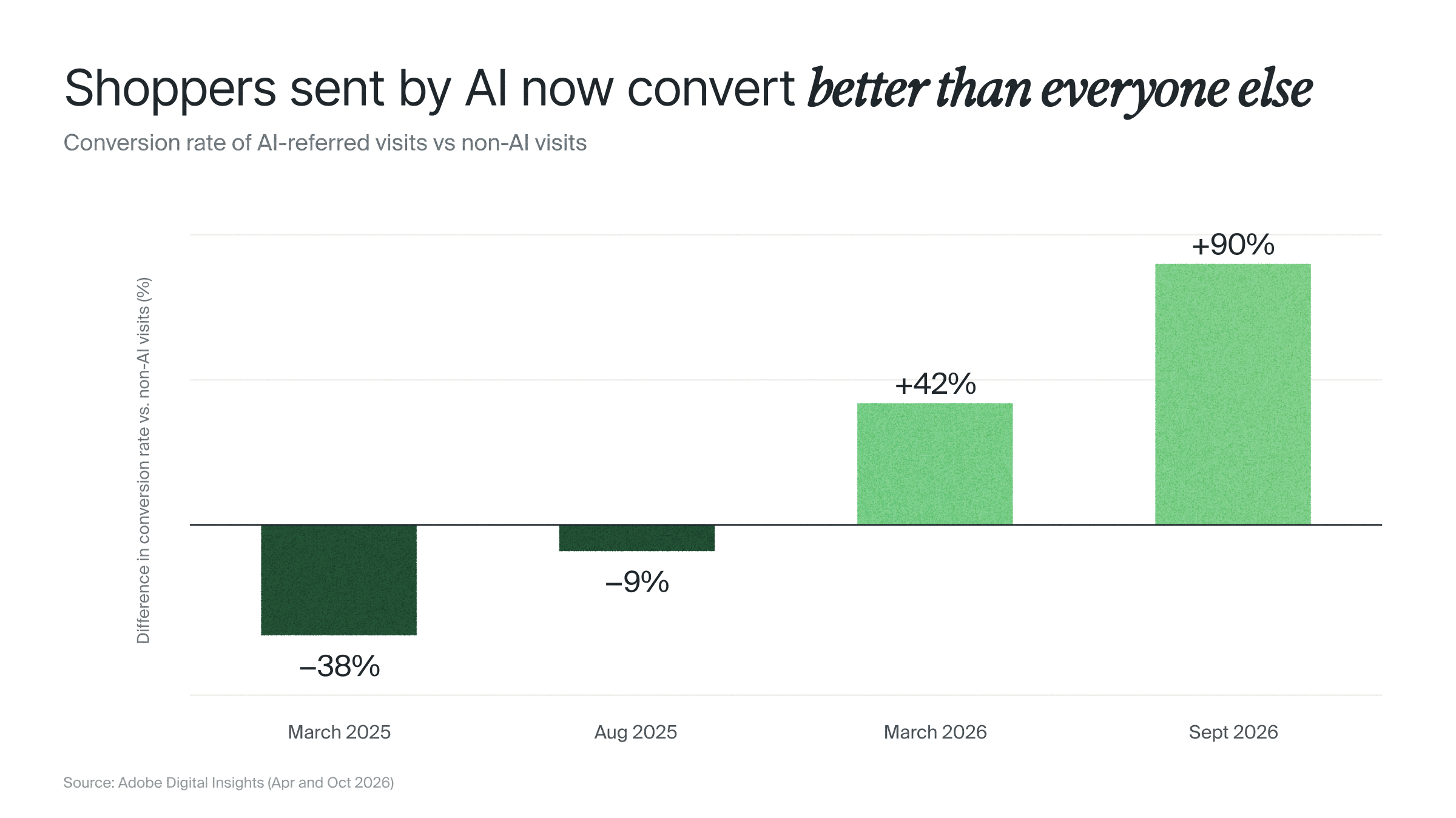
The money started moving too. Purchases by agents through Stripe's Link grew 38 times in September, from a small base Stripe won't disclose. Forter, which screens orders for online stores, saw agent orders jump 229% from a month earlier in the week it first spotted Muse. And shoppers arriving from AI now convert 90% better than other visitors to US retail sites, up from 9% worse a year earlier. That counts people clicking through from AI rather than agents buying, but it shows where the traffic is going.
How big could this get? The internet took 26 years to grow from 0.6% to about 17% of US retail sales. Bain expects agents to be involved in 15% to 25% of US e-commerce by 2030, or $300 billion to $500 billion. Morgan Stanley says 10% to 20%.
Treat those forecasts with care, because the case against them is real. Each firm counts an "agent purchase" differently, and Stripe's 38x started small. Only 4% of shoppers say they would let an agent finish a purchase on its own, and Forrester wrote in May that hype is running ahead of the actual behavior. Amazon and JPMorgan block outside agents. The Verge sent Muse shopping and compared it to an anxious, apologetic teenager.
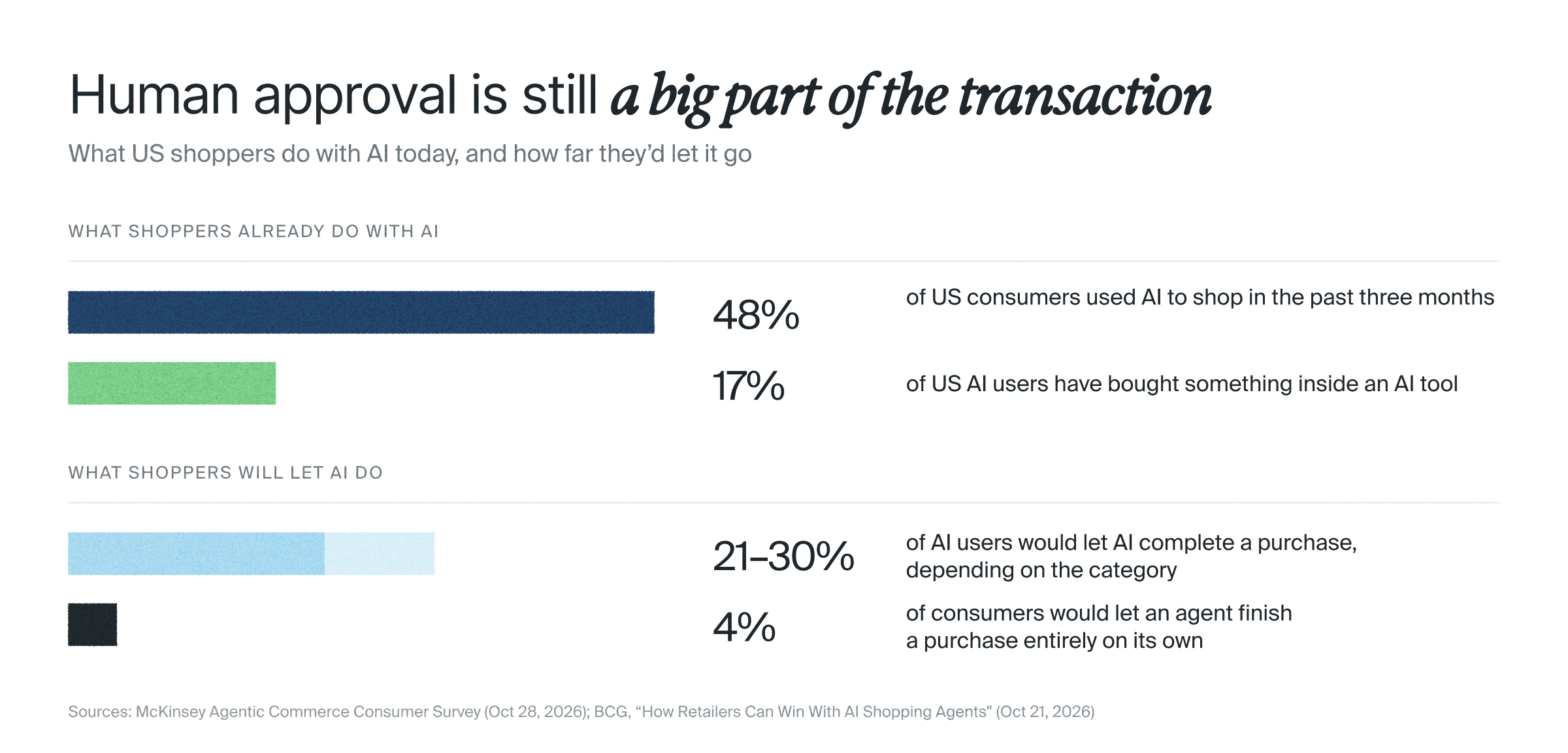
At the birds-eye level, the evidence says finding things and paying for them moved this fall. The moment the person says yes is still up for grabs, and that's where brands will win or lose.
Designing for the customer who sends an agent
Every earlier wave forced stores to decide what to let in, what to show, how the customer says yes and who's on the hook when it goes wrong. This wave brings those questions back as six decisions. Here is what the biggest brands chose this fall.
1. Let agents in, or don't.
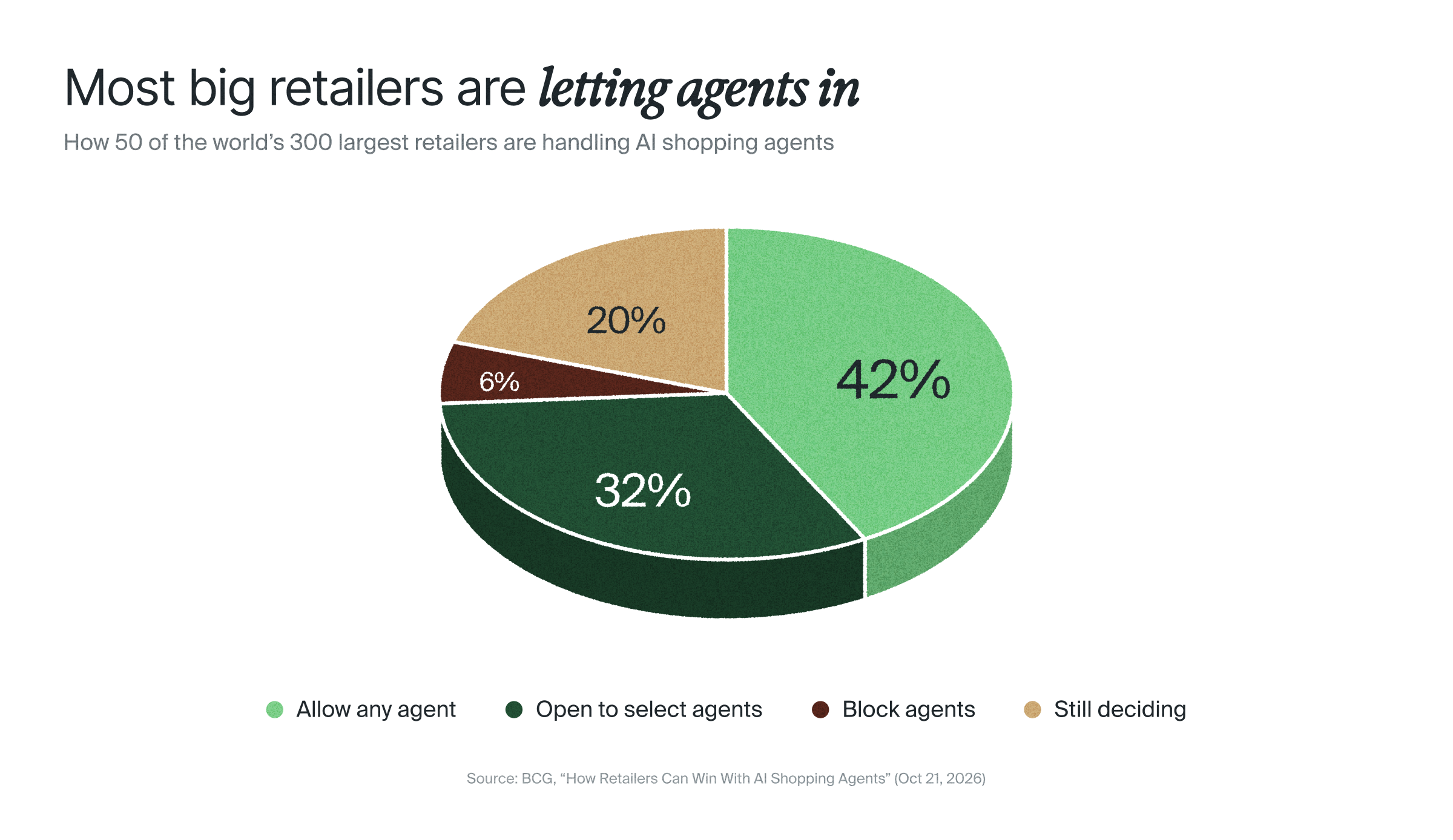
Walmart is building a gateway for agents, has set out how they must behave and has promised that "we price products, not people," so an agent sees the same prices a person does. Amazon blocks outside agents and builds its own. Both are real strategies. The worst option is the one most stores have by accident: a bot filter that can't tell a scraper from an agent a customer sent. The Verge's Muse was stopped by Target's bot check one day and let through the next.
2. Decide what agents read about you.
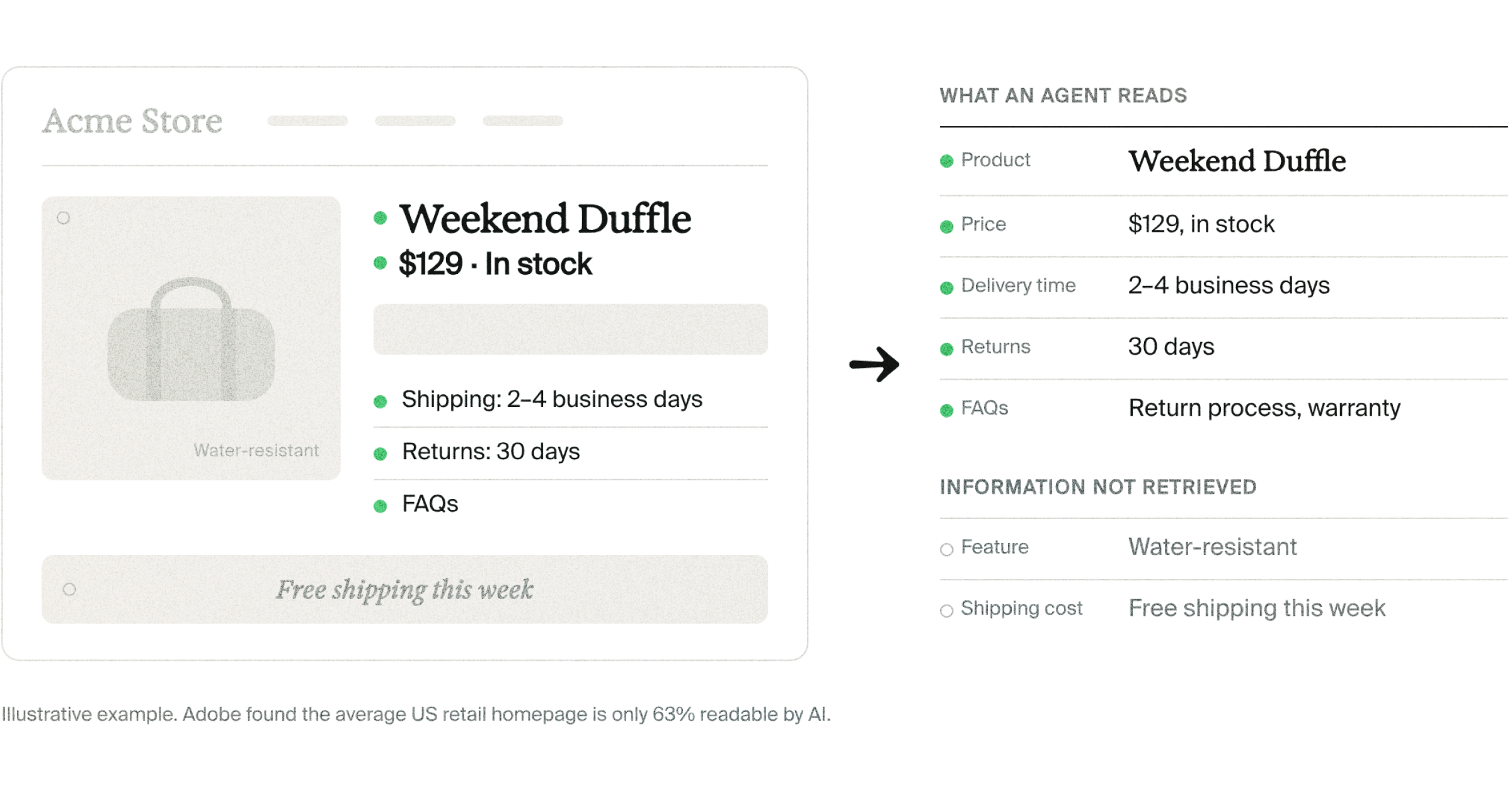
An agent judges your store by what it can read. Shopify now lets merchants review and publish the facts agents see, such as return policies and FAQs. Adobe found the average US retail homepage is only 63% readable by AI. And in more than half of AI-assisted purchases, the AI brought up a brand the shopper hadn't been considering. That brand can be yours, or a competitor whose facts were easier to read.
3. Design the yes.
For most agent purchases, the customer sees one small card with your name, the item, the price and maybe a delivery date. That card now does the job your whole checkout page used to do. Ask for approval too often and people stop reading. As Anthropic wrote about Duet, too many requests teach people to tap through them.
4. Set the limits.
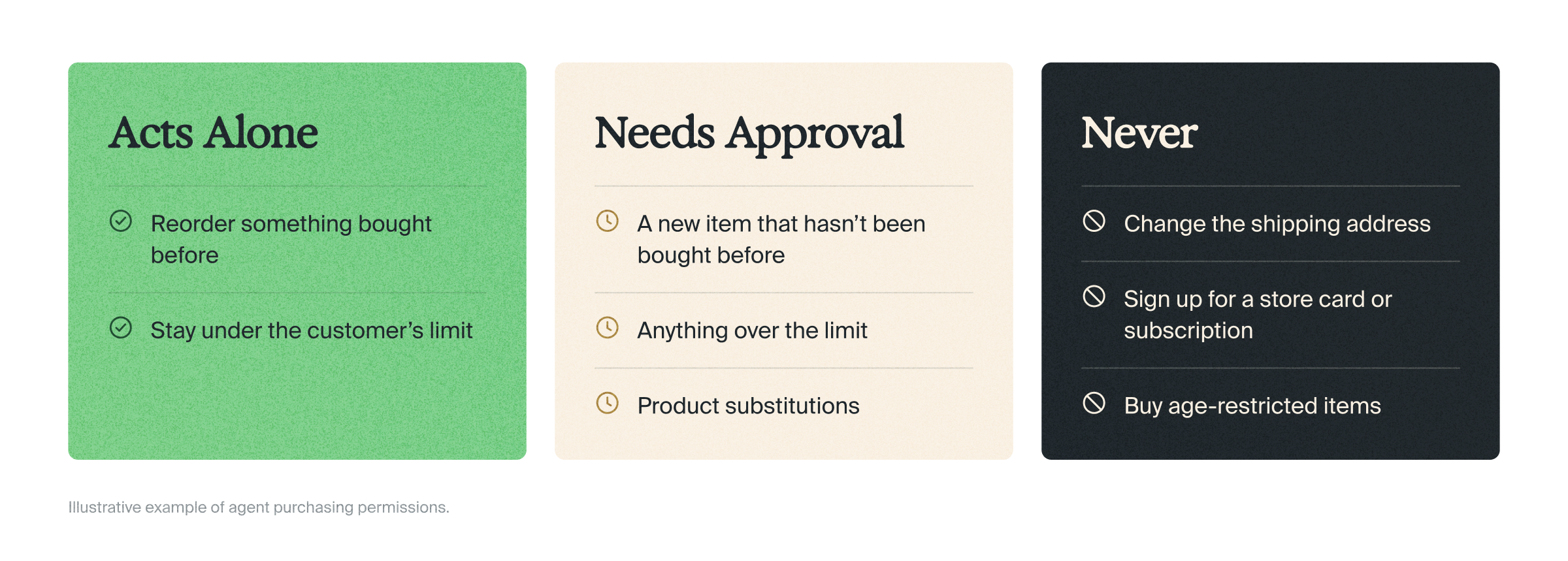
Walmart will let a customer approve every order or give an agent a spending limit of $50, $100 or $200. Decide what an agent can do alone at your store, what needs a yes and what it should never do. Expect that line to move as trust builds.
5. Decide who's on the hook.
Visa's rules treat what an agent buys within the customer's instructions as a valid charge. Walmart's normal returns apply when an agent gets it wrong. Amex says it will eventually cover agent mistakes, but only for agents registered with it. No card network has a dispute code yet for "my agent bought the wrong coat," and one-time cards make it harder for banks to see who bought what. Until the networks catch up, your return policy is the rule.
6. Meet their agent with yours.
Some brands are putting their own agent where customers already are. Maybelline put live makeup try-on inside ChatGPT. Ulta's ChatGPT app sends the cart to ulta.com with a discount.
What breaks
Blocking your own customers.
Bot defenses can’t tell a scraper from an agent a customer sent. The Verge’s Muse got stopped by Target’s bot check one day and let through the next. Decide on purpose.
The confident wrong purchase.
Operator bought eggs nobody approved. Agents still buy the wrong size. Every wrong order lands on your returns desk, not the agent’s.
Approval fatigue.
If every purchase needs a tap, people stop reading what they tap. If none do, they stop trusting the agent. The limit has to sit somewhere in between, and it will move as trust builds.
Disputes nobody can settle.
A one-time card turns one purchase into two transactions, which makes it harder for banks to see who bought what (The Information). Until the networks write rules for agent disputes, your policy is the rule.
Agents that don’t say they’re agents.
That was Amazon’s complaint about Muse. Expect more stores to require agents to identify themselves, and more agents to comply.
Believing the headline numbers.
Stripe’s 38x growth started from a small base, and the 2030 forecasts each count something different. Your own numbers are the only ones that count.
Earning the customer
Montgomery Ward had a post-office box and a newspaper calling him a swindler. What won shoppers over was a promise they could hold him to.
Amazon and Walmart have made opposite bets on agents, and both are betting the wave is real. Most stores don't need to copy either one. They need an agent to be able to get in, read what it needs and come back to the customer with a yes the customer trusts.