
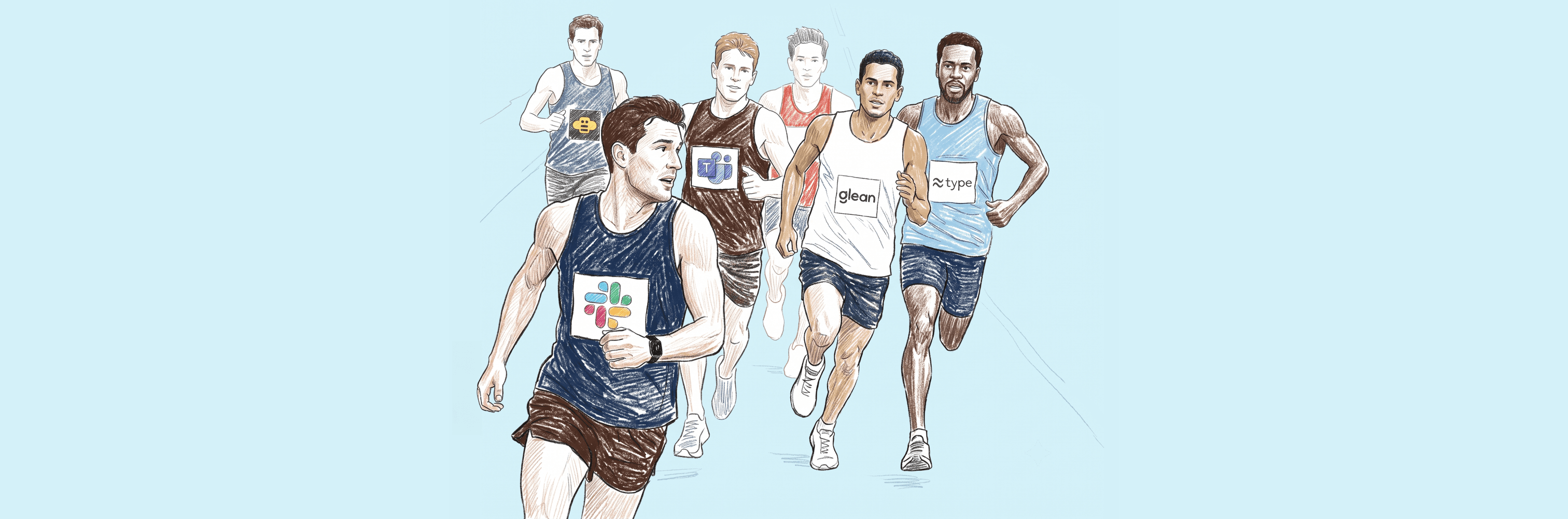
Slack is under Attack: Five challengers betting on where work is going.
Slack won by designing for a specific community. That community has changed. Here's what five products are betting to replace it. In late 2013 someone at my startup dropped a link in an email thread and said we should try this thing. What I remember isn't the features. It's how it felt.
It felt like what work was supposed to become. Fewer meetings. Less walking up to desks. Something that actually functioned for teams going remote and for engineers who lived in a terminal.
And that last part was not an accident.
Slack was built by a game studio for itself. Tiny Speck's engineers built it because they needed it, so the early product felt pretty intentional - designed and built by the community that needed it most.
Developers embraced it first, and this was made obvious from the interface and early features: advanced functionality lived behind slash commands, syntax highlighting, and the integrations people cared about; GitHub and error trackers. Slack simplified all of that years later as it pushed into the enterprise, but the DNA was set.
That's the part I think gets underrated. Slack knew exactly who its customer was. Engineers who worked in small teams and moved fast. People who had grown up in chat, in IRC, in games. So Slack gave them something as easy as chatting, with jokes in the loading screens, and it made them feel seen.
We talk a lot about products becoming relationships, but in Slack’s case, the relationship wasn't with the software itself. The relationship was with your colleagues, and Slack made that easy and fun. Design as an act of knowing your community.
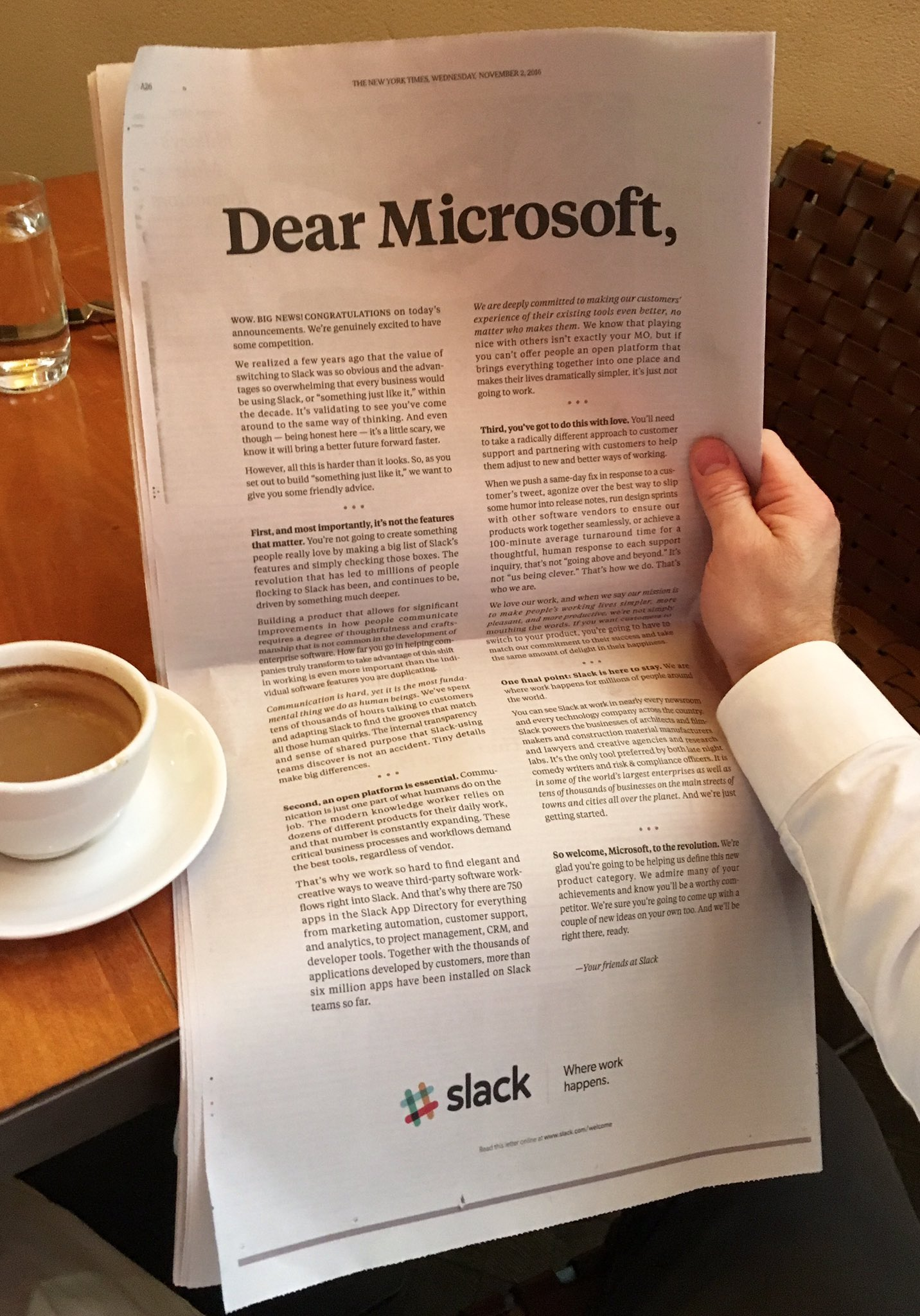
Then nothing much happened for a decade. Microsoft came closest, and not on product innovation. Teams launched in 2016, Slack bought a full-page ad in the New York Times to welcome them, and then Microsoft put Teams in Office at no extra cost and let procurement do the arguing. Slack filed an EU antitrust complaint in 2020. The ad became an artifact.
The customer changed.
Slack was built to fix communication. It did. It also produced a new kind of problem, which happens to most tools that win.
Microsoft's research has knowledge workers hit with an interruption every two minutes during core hours, 275 a day.
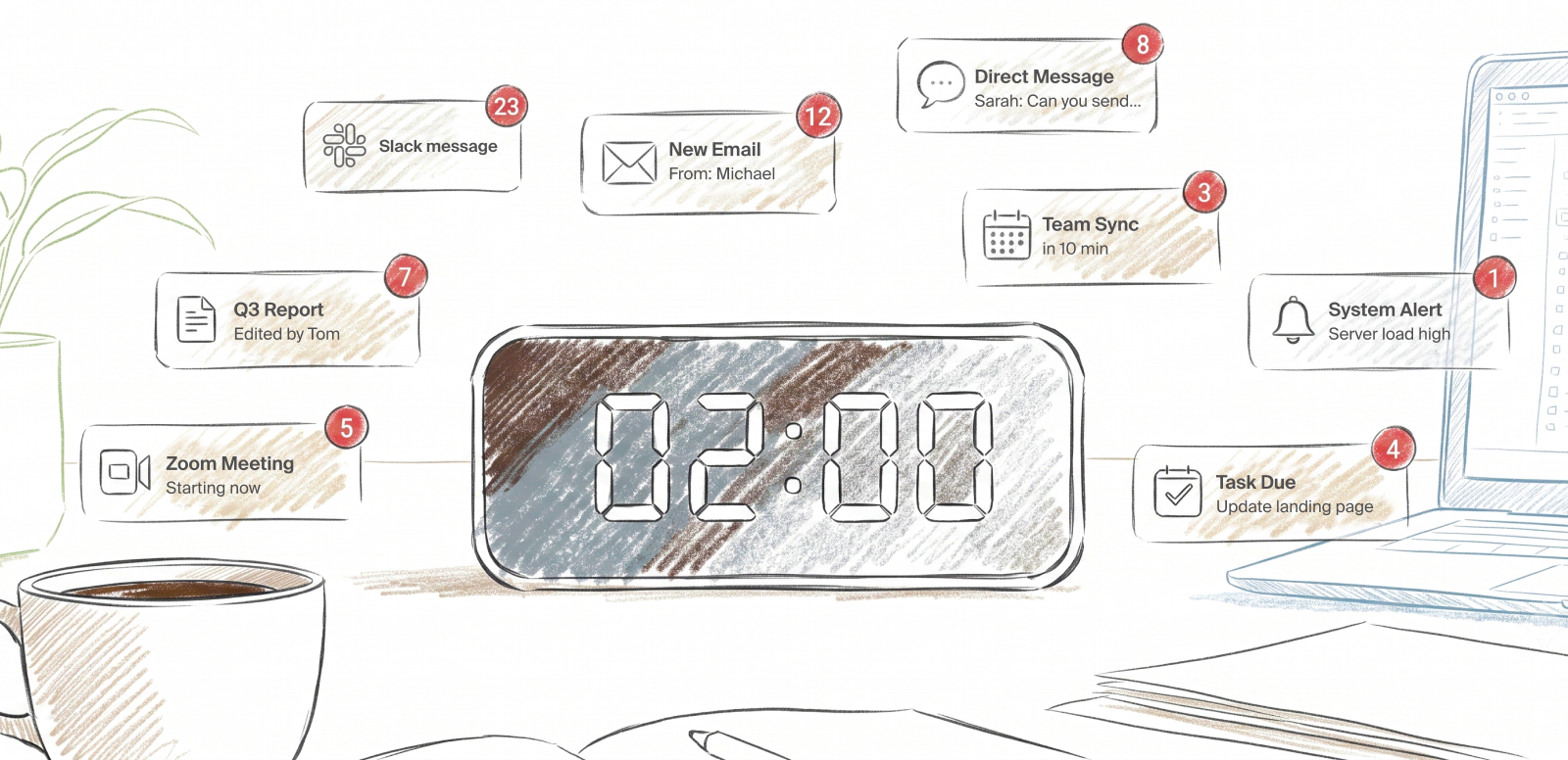
Carnegie Mellon's HCI group found notifications degrade your performance even when you resist them, because deciding not to look costs about the same as actually looking at the notification.
So Slack added new surfaces. Canvas for docs, Lists for kanban, Huddles for calls, Clips for video, Workflows, Save Later. Each one reasonable. The sum is a different product than the one that won, and reviewers keep landing on the same note about Canvas: no folders, thin formatting, too informal to hold anything official. The document surface can't be the record. Meanwhile about 80% of employees would rather ask a question in chat than search a wiki, so knowledge keeps flowing into the surface that is naturally at odds with what is becoming increasingly important: context.
Through all of this, work is changing, and Slack isn’t on their own island anymore...
Nobody is trying to usurp email anymore. Email found its place. Communication is a solved problem, or at least a settled one. The fight has moved to a different layer: not where you talk about work, but where and how work actually happens.
That's a different customer with a different job. In 2013 the customer was an engineer who wanted to talk without leaving the terminal. In 2026 the customer is anyone whose work is increasingly done by systems and agents acting on their behalf, across tools that don't talk to each other, with output that needs checking.
That person doesn't need a better place to chat. They need somewhere to direct the work and see it come back, and ideally without missing a beat.
Slack’s bet
The not-so-fun-fact about Slackbot: for most of its life it was a search box with a personality. Ask it something, get an answer, and it kept nothing.
That changed a few weeks ago. Slackbot now builds memory from your conversations, checks weekly for new activity, and stores what it learns as preferences and topics. Slack's framing: week one it knows your name, week eight it knows your stakeholders and what "urgent" means to you. They shipped MCP with it, so Box, Figma, DocuSign and Linear can put live panels inside a conversation instead of firing a notification and walking off.
Read it as strategy. Slack has the conversations, the documents, the recorded huddles, the connected tools, and now a memory layer over all of it.
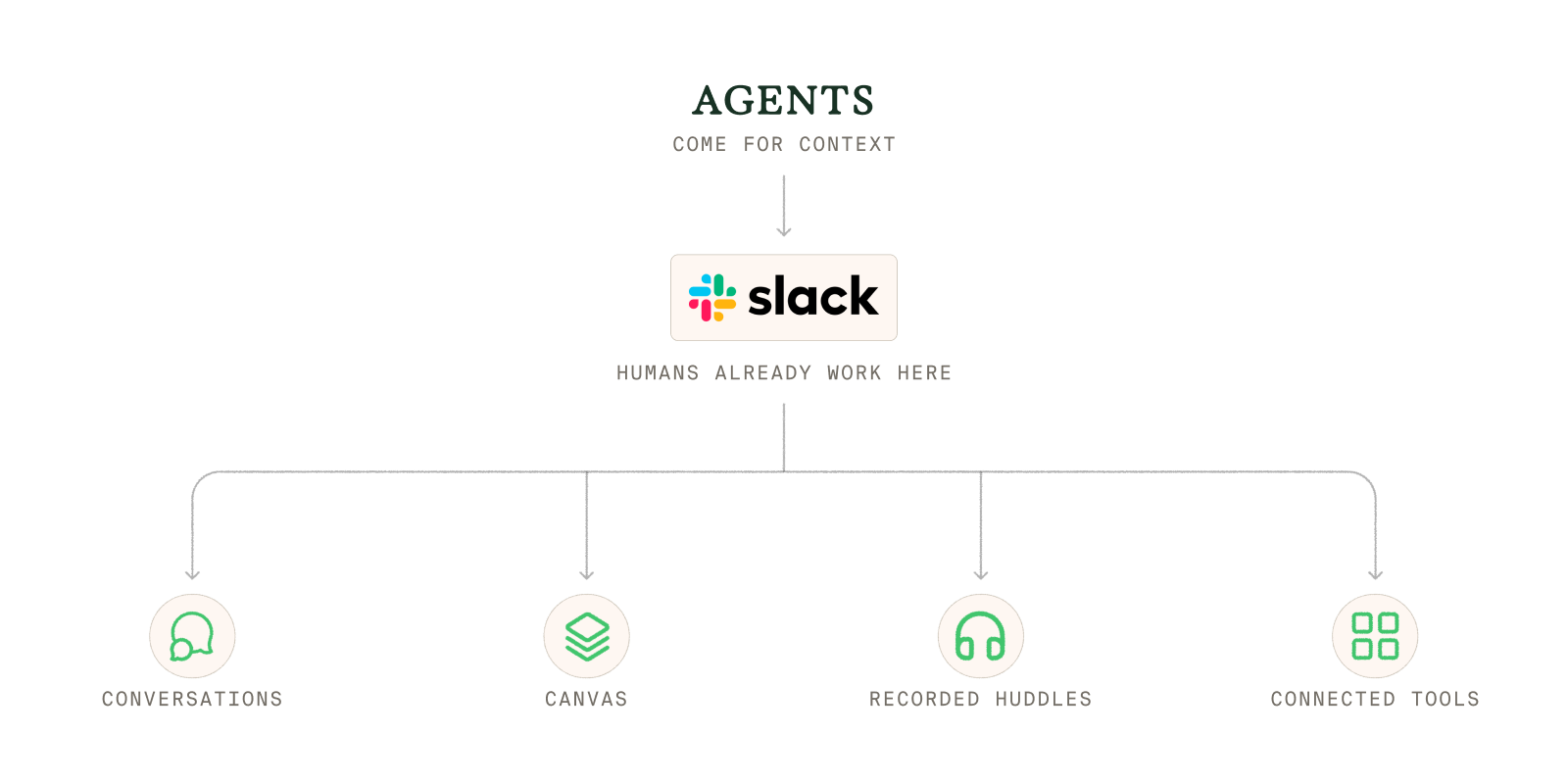
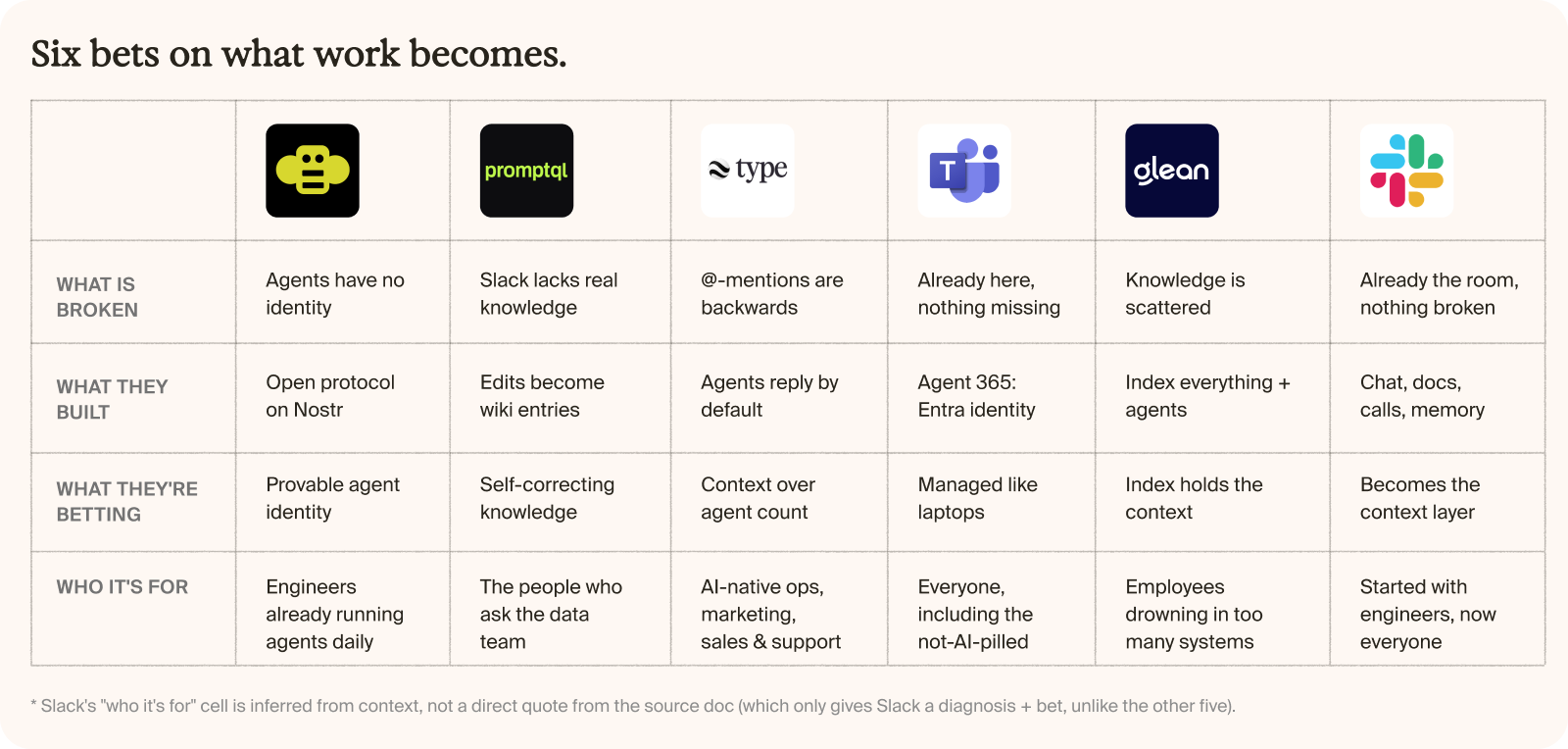
Slack isn't trying to build the best agent. They're trying to be the place every agent has to come for context.
The diagnosis underneath is that they're already the room where it happens, but the next generation is coming up fast. The bet is that the room becomes the context layer and everyone else has to knock. It's aimed at the companies already living in Slack, which is most of them.
Strong position. Which is why the interesting question isn't whether Slack is in trouble. It's what five other products think they can see that Slack can't.
The challengers: Five bets on the future of work (and collaboration).
Every new entrant is really an argument about what Slack is missing and where agentic work is going. Each one is a diagnosis, a product, a bet, and a very deliberate choice about who they're talking to.
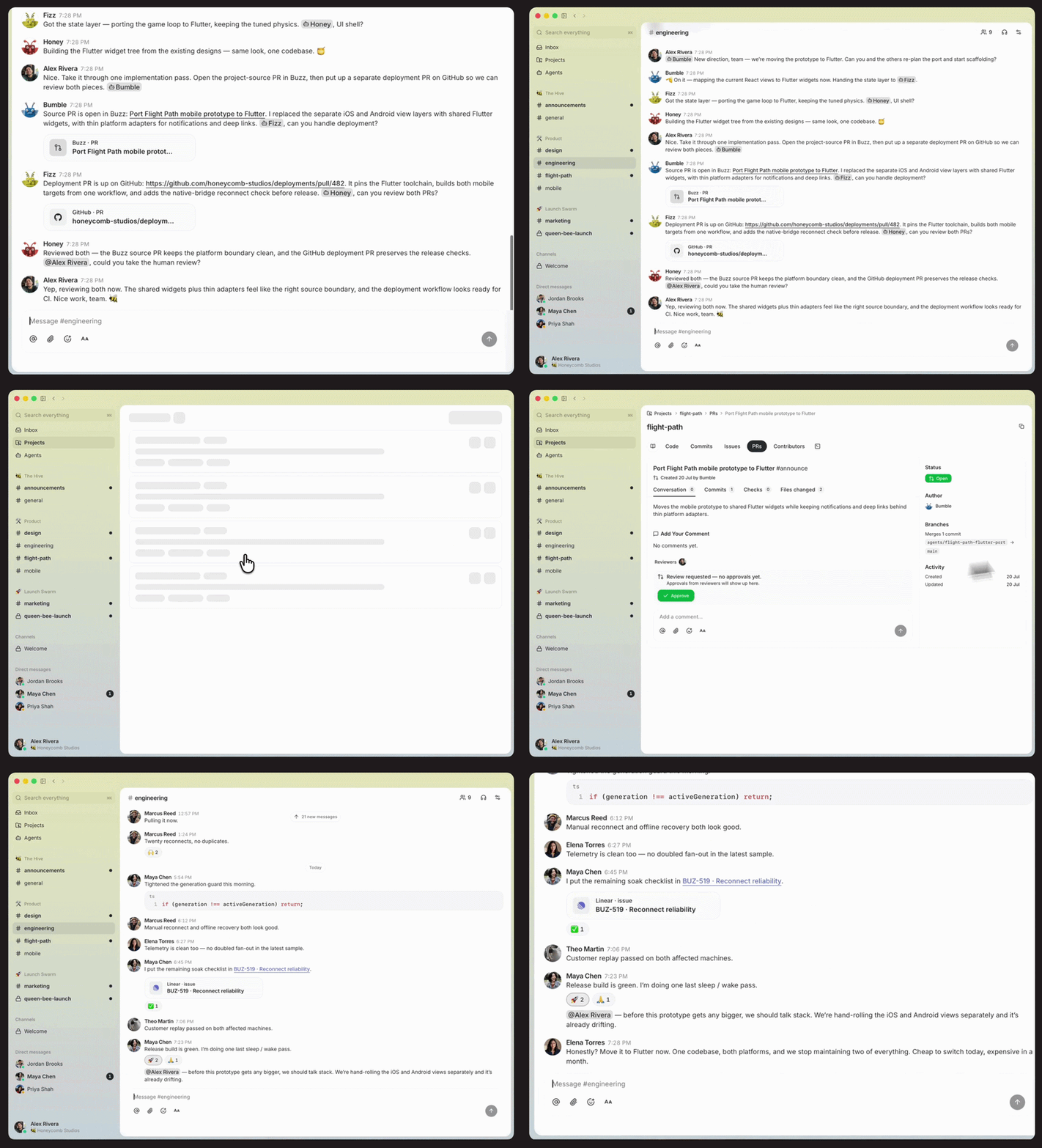
Buzz (Block, open sourced in July)
Diagnosis: the workspace is proprietary and agents are second-class citizens with no identity of their own.
Product: an open protocol on Nostr where every participant, human or agent, holds its own cryptographic keypair, with the sharpest principle in the category, that authorization does not erase authorship.
Bet: work becomes swarms of agents, and swarms need provable identity and audit trails more than they need a nicer inbox.
Who it's for: engineers who are already running agents every day and want to run them somewhere they control. Bee world, hive metaphors, chartreuse, self-deprecating engineer voice, distributed through GitHub. Crypto-adjacent by association and explicitly not blockchain, which their README notes is useful without making everyone buy a commemorative coin. The README is the tell. If you don't read them, this isn't aimed at you. (buzz.xyz)
PromptQL (Hasura)
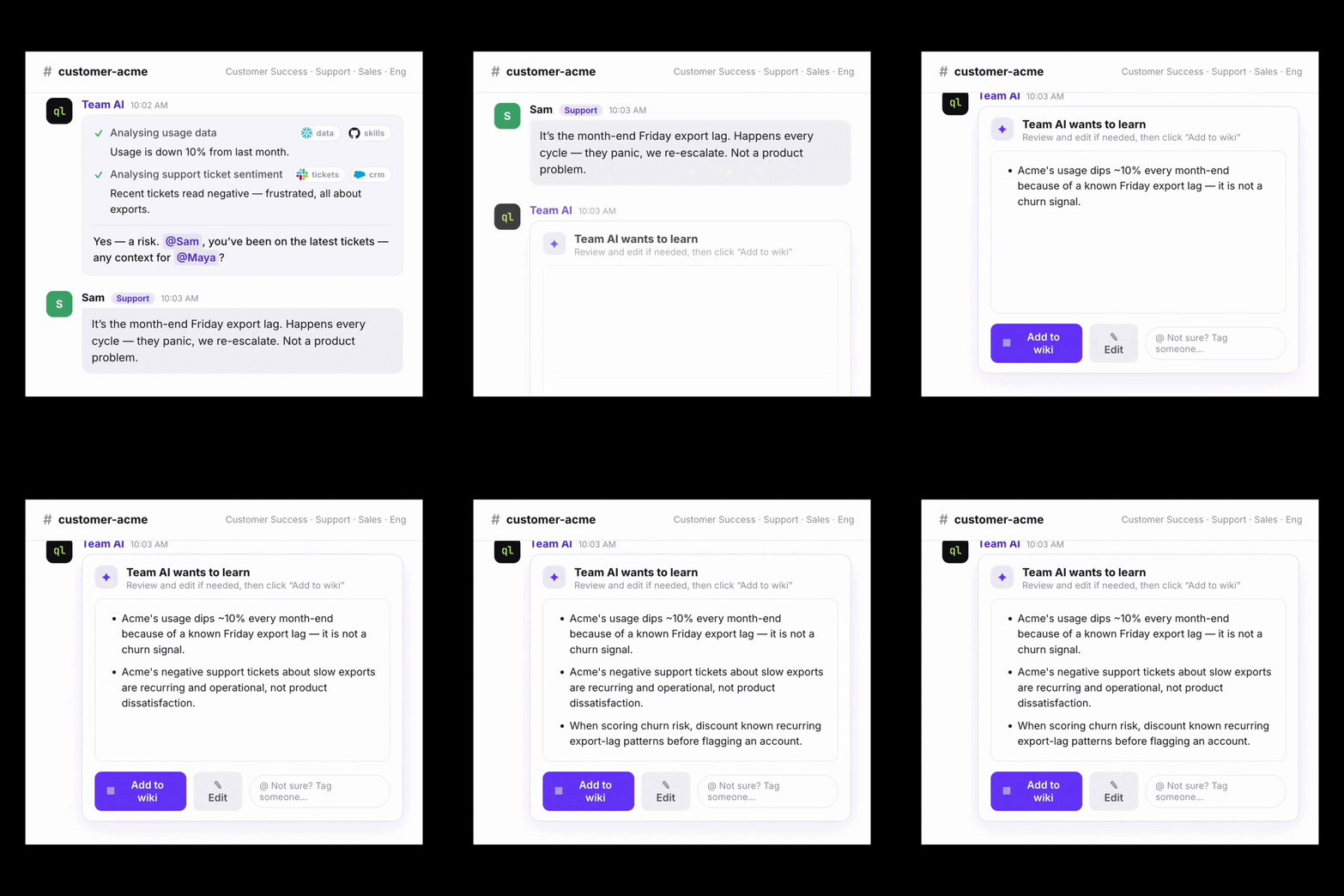
Diagnosis: Slack holds all the conversation and none of the knowledge, and maintaining context is unpaid labor.
Product: shared AI threads where corrections become approved wiki edits, cited and versioned via the embedded agent - multiplayer (agents + humans) is a core primitive today.
Bet: the durable asset of work is a knowledge base that corrects itself, not a transcript or messages lost in threads.
Who it's for: the person who currently has to ask someone else. Customer success wondering if an account is a churn risk, demand gen chasing a number, the person pulling revenue for a board deck who doesn't know the source table moved last quarter. The company is data-mature. The user just wants an answer. (promptql.io)
Type
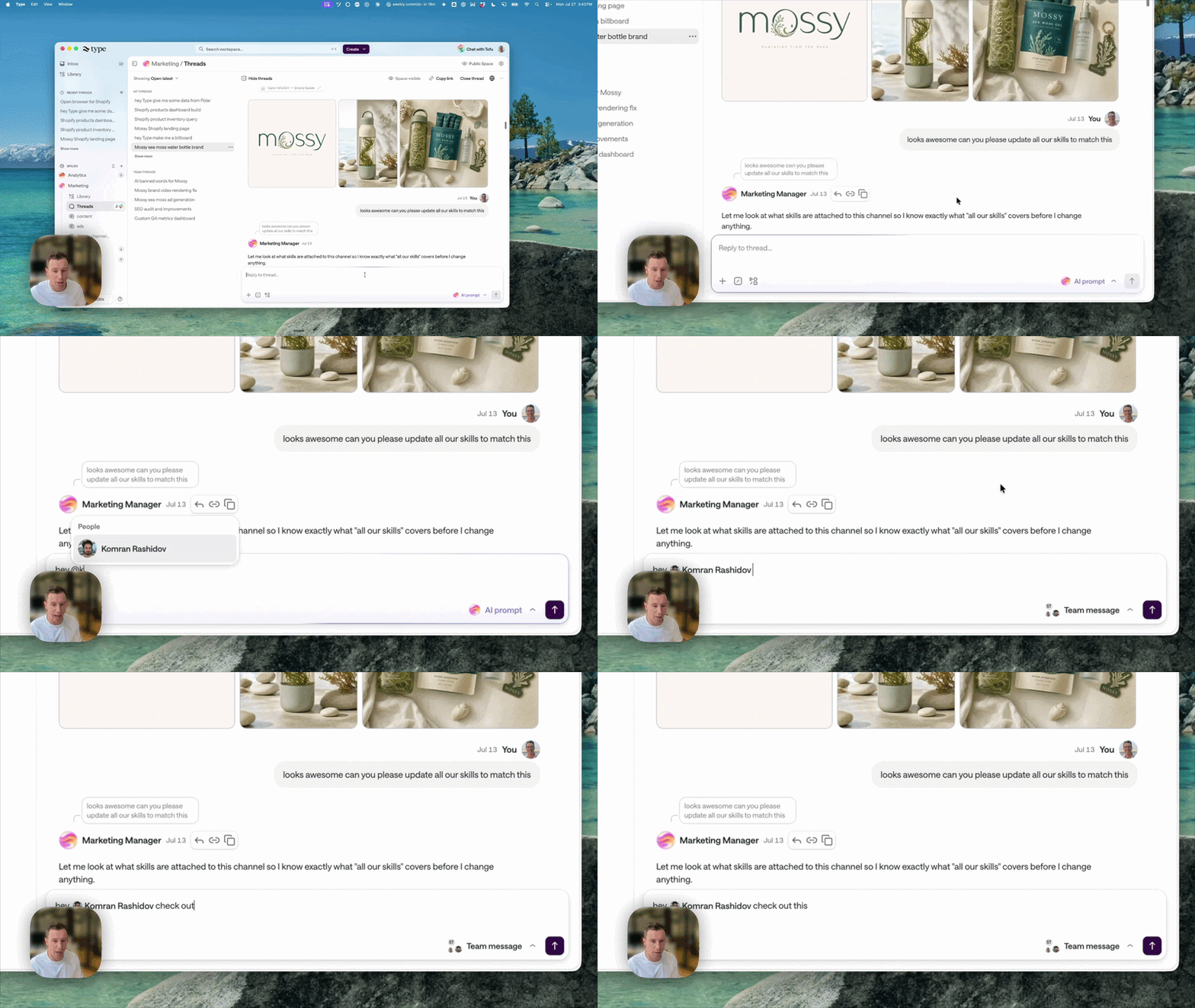
Diagnosis: @mentioning an agent every single time is backwards, and the number of agents you run is a vanity metric.
Product: agents reply by default and you flip to team chat for humans only, with spaces that work like shared computers holding their own memory, connectors and skills.
Bet: you're not managing agents, you're managing contexts.
Who it's for: the departments Slack never really courted. Ops, marketing, support, the people whose work is already half-delegated and who never got a tool designed for that. It connects to Slack so you migrate gradually. (type.com)
Microsoft Teams
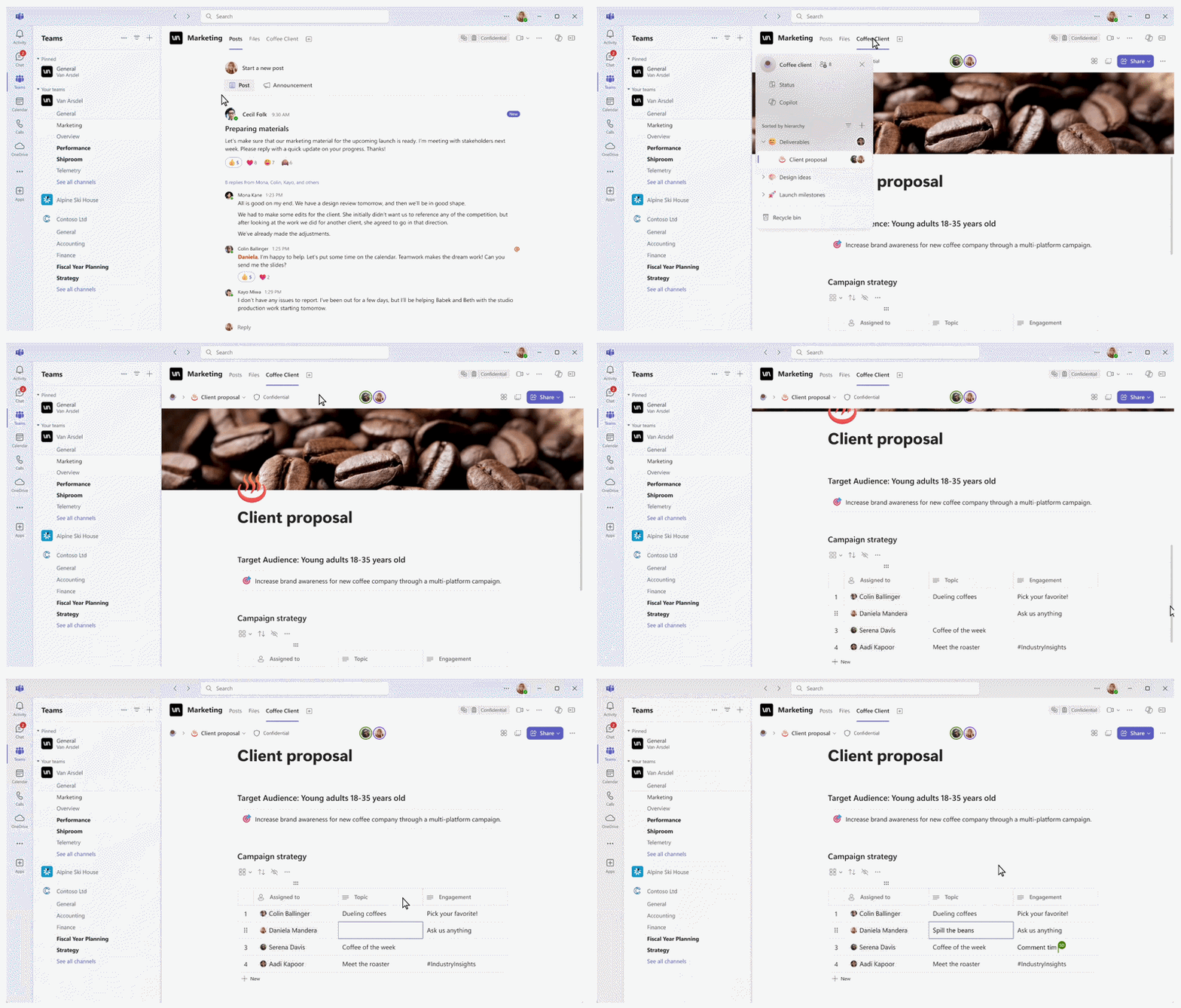
Diagnosis: nothing is missing, it's already here and IT already approved it.
Product: Agent 365, giving agents an Entra identity that IT provisions and revokes across Teams, Outlook and Word.
Bet: agents become managed corporate assets, governed like laptops.
Who it's for: the entire workforce of a legacy enterprise, including the people who will never say the word "agentic" out loud. Safe, familiar, bridges a 24-year-old and a 60-year-old in the same org. That's the strategy rather than a failure of ambition.
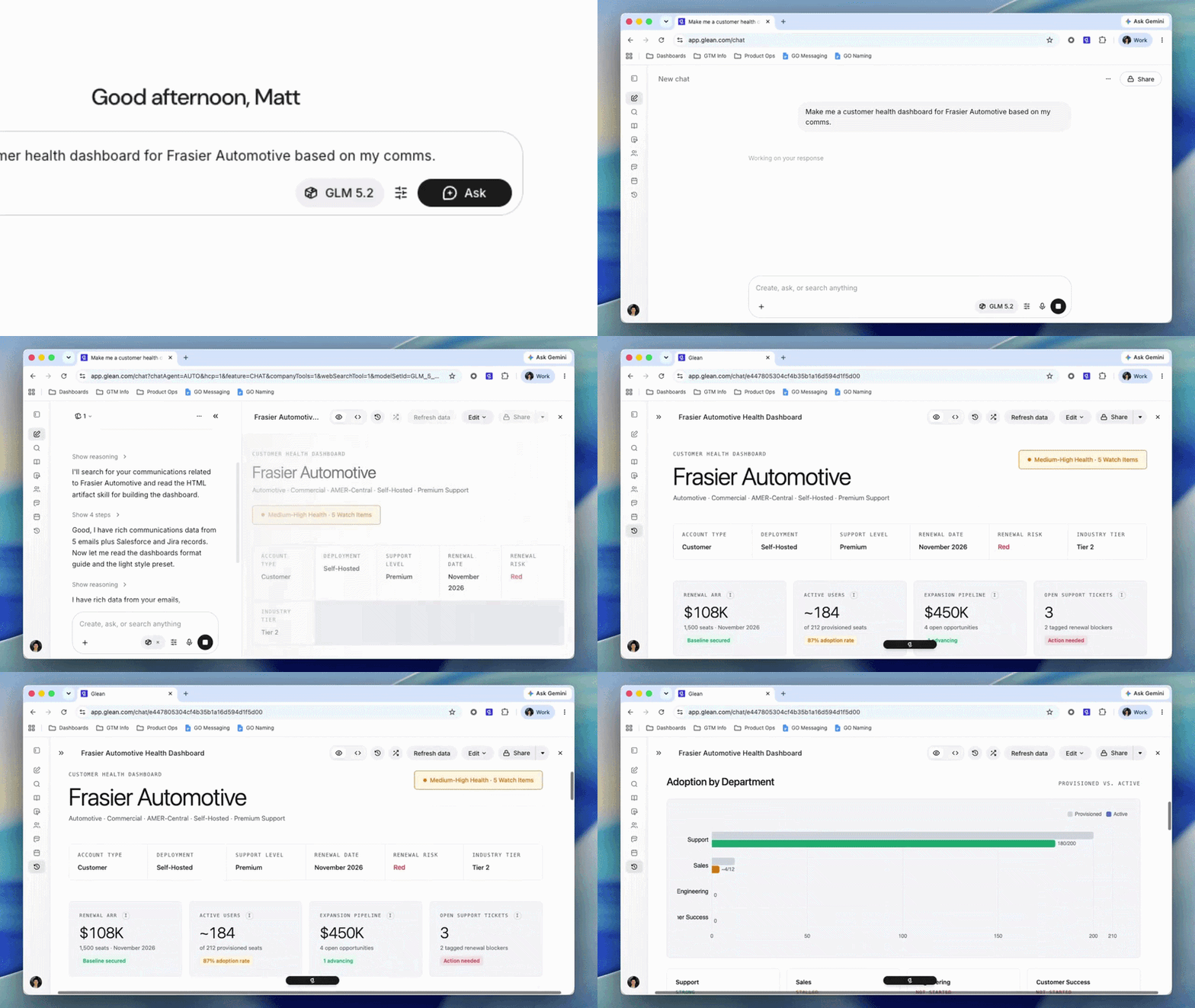
Glean (this is a light prediction)
Diagnosis: the answer was never in chat, it was spread across every system you own.
Product (today): index everything, then put agents and a canvas on top.
Bet: whoever holds the index holds the context.
Who it's for: employees at big companies running hundreds of systems that don't talk to each other, where the answer already exists somewhere and nobody can find it. They want an answer, not an agent, and they'd be happy never learning the difference. Larger orgs that need ‘insurance’ and a turnkey solution for universal search, context, and agentic governance. Worth watching because it has every component of a workspace except people talking to each other (glean.com)
Here’s a quick breakdown:
What they agree on
Six products, six diagnoses, but there is a shared read on where work is going.
Work is moving from communication to delegation. For a decade the job of a work tool was to help you talk about the work. The job now is to help you hand it off, watch it happen, and check it. That's a different job, and it needs a different interface.
Everyone becomes a manager. We’ve been beating this drum for a while now (in fact, we first dropped this with an AI scale up in 2024) and the products are starting to reflect it, in a very literal way...If execution gets cheap and abundant, the scarce skill becomes knowing what to ask for, giving enough context to get it, and judging whether what came back is any good. That's management, and it's arriving without the title or the training.
Context is the asset, not the conversation. Every serious product here has picked something durable to sit underneath the chat: a signed event log, a self-correcting wiki, a space with its own memory, an enterprise index, a governed graph. .
Multiplayer is the future. The first wave of AI at work was one person and a private chat window. Everything here is a bet that the next wave is a team and a shared thread, because context that lives in one person's chat history never compounds to the rest of the crew.
The design problems nobody has solved, yet.
Some big design questions that don’t have concrete answers yet surface, and they’re not just for this category of ‘the future of work’ - whoever answers them well will define how agentic products feel for years (months?) to come.
1. Where does the work happen, and how do you know?
In a chat app with agents, some things get done in the tool and some things get done elsewhere and reported back. Right now that boundary is invisible. You can't tell by looking whether an agent finished something or described finishing it. That's a UX problem with real consequences, and nobody has a good pattern for it.
2. One agent with helpers, or many agents?
Buzz says swarm. Type says the number of agents is a vanity metric. Both are shipping, and they can't both be right about how people want to work. This is the single biggest unresolved question in the category.
3. How much personality should an agent have?
Personify it and the hope is that people trust it faster, but maybe trust it more than it deserves. Give it none and it feels like a search box or ‘just another chatbot’. The category has defaulted to "teammate" but beyond that, the jury is out on how to brand the identity of these new teammates, and how it varies from product to product.
4. Marketplace or native?
Slack's answer is an ecosystem, thousands of apps built by other people. Type's answer is native spaces you configure. A marketplace gives you range and inconsistency. Native gives you coherence and limits. Every platform in this category is picking a side, and while it’s not one-to-one with the App Store vs the native iOS apps, it definitely rhymes. The difference here is you might very well have people wanting to bring their own agent to the party. Then what...?
5. What does memory look like when you can see it?
Most memory in these products is invisible, which means you can't tell what the system knows about you, correct it when it's wrong, or take it with you when you leave. PromptQL is treating memory as something you can read, edit and cite. Arguably, that should be a table stakes ‘trust builder’, but in practice, memory and context are a little bit different, and who knows how much ‘editing’ people will want to do...
6. How do you supervise more than a few?
The @-mention was designed for summoning one agent. It works fine for one and falls apart at 10. Nobody has designed the perfect review UX. The place where you see everything running, what needs you, and what can wait. This is the biggest gap on the board. We have this in Claude and the other frontier apps, but is that the best way?
7. Who is it for?
Slack got this right in 2013. Buzz is designing for the AI-pilled and tech-native ‘early adopters’ with the same precision Slack once used on engineers. Teams is designing for everyone else. Type is designing for the departments Slack never courted. All three are defensible. What doesn't work is a product that can't answer the question of who it’s meant for.
What does this mean?
Design is still an act of knowing who you're for, the problems you’re solving for them, and the ability to connect with them while unlocking the power of the underlying tech.
Slack won because it was built by its customer, for its customer, and it felt that way. The products that win the next decade will be just as specific about who they're building for, while working on the open questions above, and bringing their community with them into an age of new patterns and deeper, trusted relationships with almost no limits.
Slack's position is stronger than the noise suggests, and their challenge is the hardest kind: change how people interact with their product without breaking what made them love it. New startups are already exploring alternatives, and as more AI-native products enter the scene, we’ll see how strong the Slack<>Company relationship truly is.