

How to Become an AI-Native Company
Being AI-native is not the same as using AI. Most companies are AI-assisted, not AI-native, and the gap between the two is widening. The companies that get this are about to make everyone else look like they're standing still.

There's a $1T+ difference between "using AI" and being "AI-native" and most companies have no idea which side they're on.
Using AI means you're still doing the work with a faster assistant next to you. Being AI-native means the agents do the work and you move up to the strategy, the taste, and make the calls only a human can make.
The gap between AI-assisted and AI-native is where most organizations are stuck, and where the real opportunity lives. This article is where we define it clearly, show what the system looks like in practice, and give you a framework you can actually use.
The System
Being AI-native changes the organization structure itself. It runs on three layers, and you need all three or it doesn't work. An AI-native organization is one that implements a system where people manage agents, agents can read and write to your company brain, and the company gets smarter over time.
tl;dr: People managing agents with context.
Big decisions lie in the judgement that gets encoded into the system, and the judgement on what an agent should do, and what a person should do.
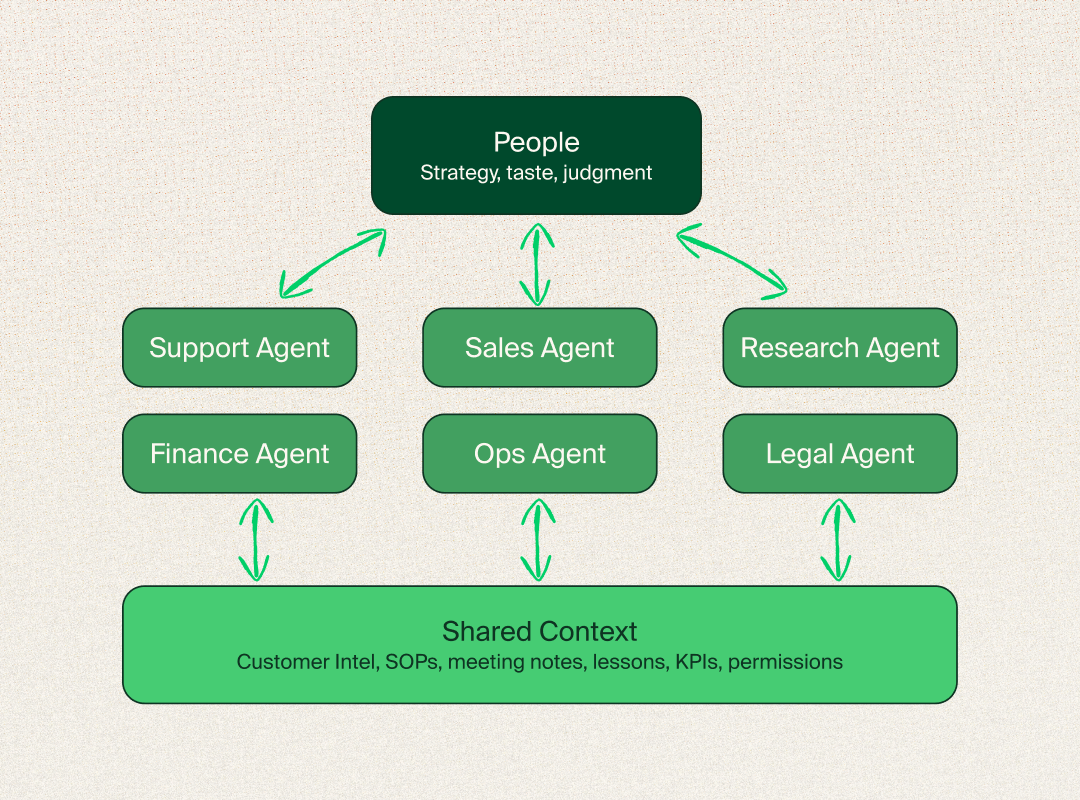
That system produces speed.
Speed gets you signal from the market.
Market signal feeds back into the system.
The loop compounds, and that compounding is your competitive moat.
Speed without direction, though, is just noise. Demis Hassabis put it well at Google I/O: "Running 100 miles an hour in the wrong direction is worse than standing still." The goal isn't to move fast for its own sake. It's to move fast toward your goals and providing maximum value to the customer, guided by real signal.
Layer one: People
There is no AI-native organization without AI-native people. You can wire up every agent and deploy every tool. It won't matter if your team doesn't know how to manage them, or doesn't yet see the value in learning.
Pre-AI, most of your working day lived in the execution middle. Research, drafting, formatting, building.
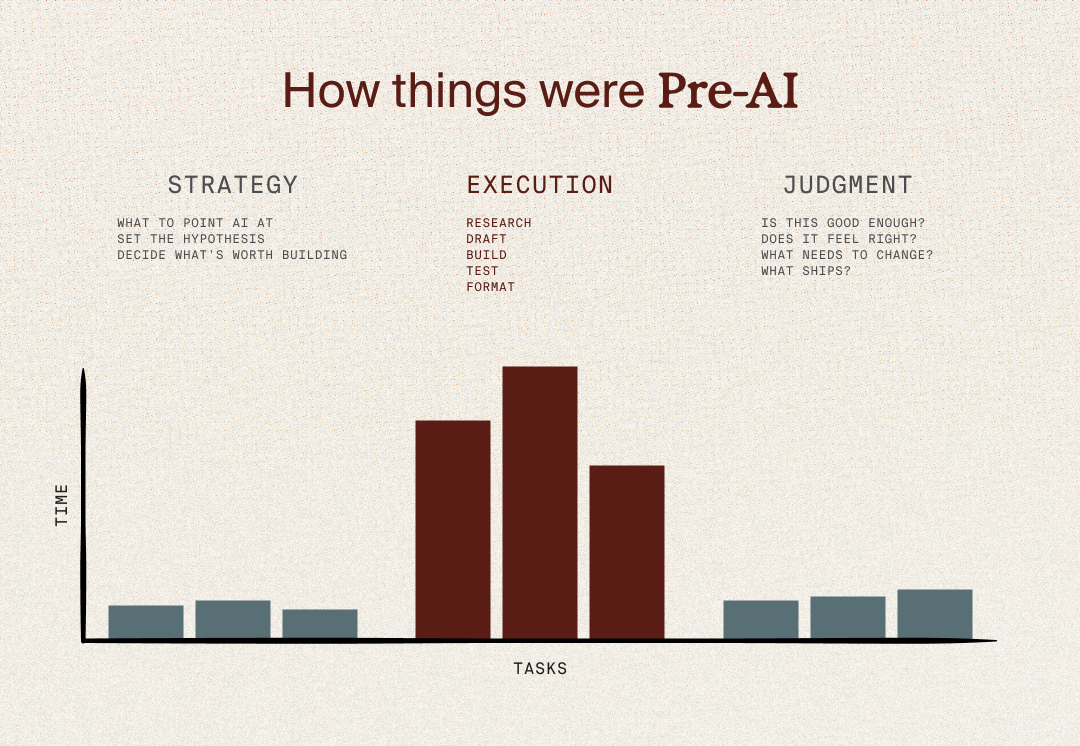
The bookends, deciding what's worth doing, and judging whether the output is good enough to ship, got squeezed to the edges. They were the most important work, and they got the least time.
AI eats the middle. It handles the execution. That frees people to spend more time where their judgment, taste, and experience actually matter: at the front and the back.
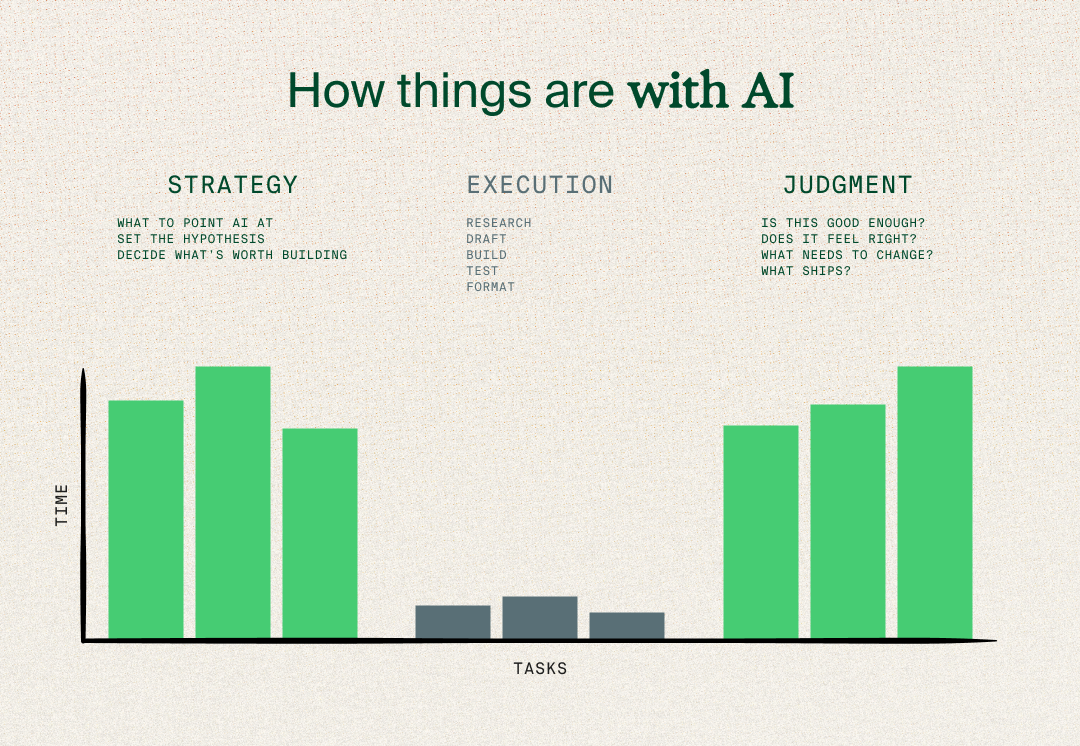
Which means the role shift is real: everyone is now a manager.
As Andy Grove put it, a manager is judged by the output of their team. You now have a near-unlimited team. Your job is to set them up to win.
Layer two: Agents
Agents are models using tools in a loop. Most teams are stuck at one of two levels: chatting back and forth with a model, or babysitting an agent and clicking approve on every step. The level you actually want is a meaningful degree of its own autonomy. An agent that runs for hours, comes back with quality work, and lets you focus on reviewing and making it right for the customer.
To get there, an agent needs four things:
Goals: not just a task, but a clear definition of what success looks like. Specific, measurable, and timely. This is the new prompt.
Skills: repeatable playbooks that encode quality standards, voice, and process. SOPs your agents can actually use. The more recursive, the better.
Tools: access to what it needs to do the work. MCP connections, internal systems, external APIs. These are your agents 'hands'.
Context: a real understanding of the organization it's working for. More on this below.
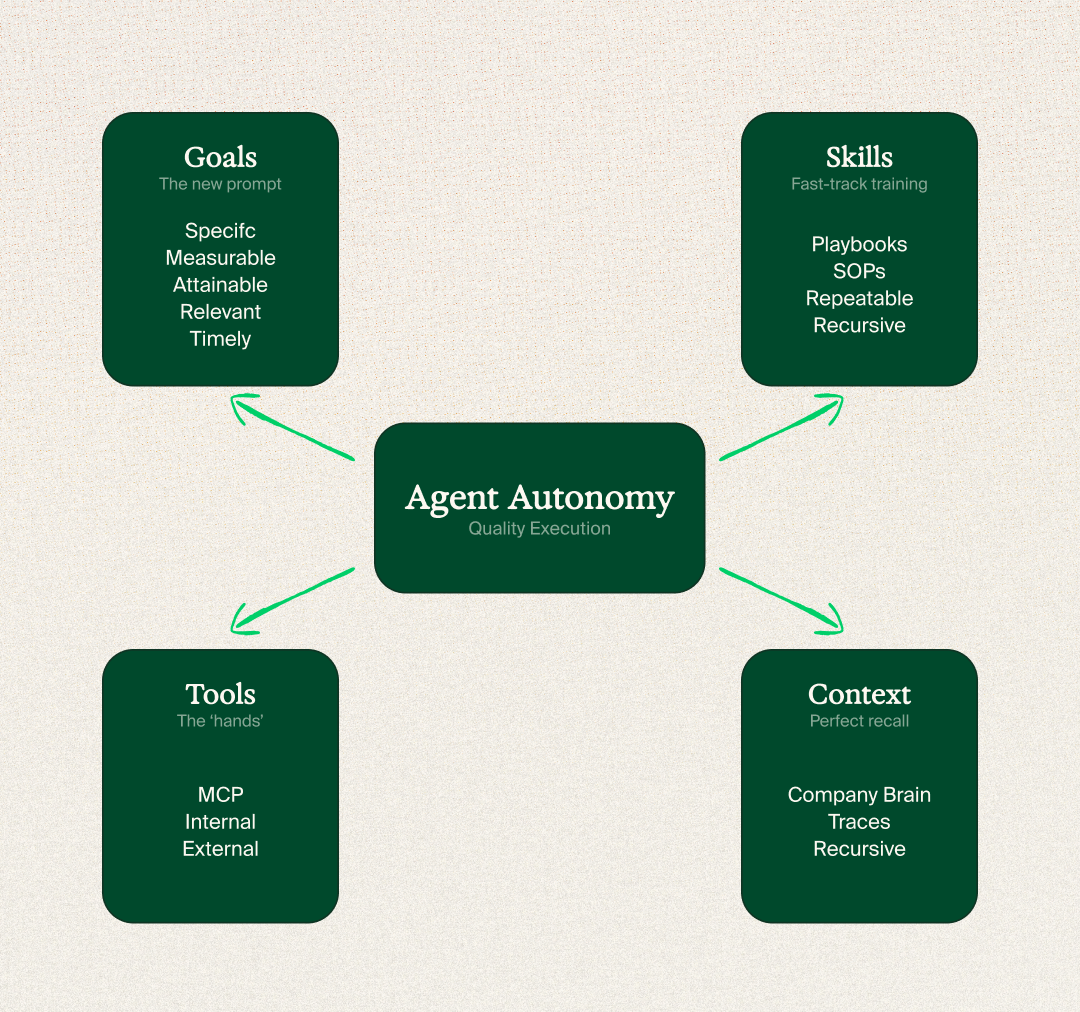
Think about your first day at a new job. If someone handed you a complex deliverable with none of those four things in place, you'd produce something unimpressive, not because you lack capability, but because you were set up to fail. People get frustrated with AI for exactly the same reason.
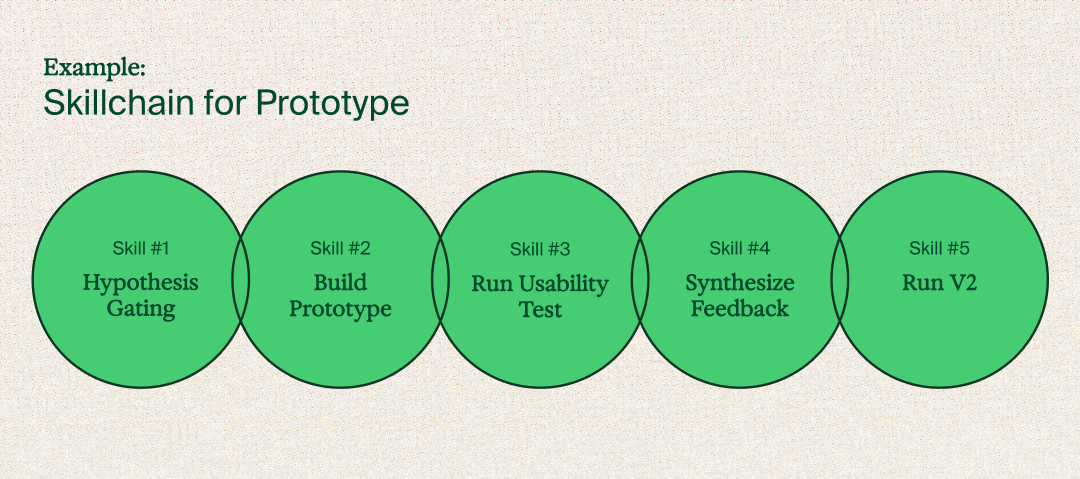
One thing that meaningfully closes the gap: skill chains. These are playbooks that run back to back. A macro-skill made of smaller skills firing in sequence.
For example, a proposal flow might run three skills in order: build a microsite, write copy in a specific voice, QA the whole thing. Each skill enforces a quality bar. Together they produce something repeatable and high-fidelity. This is what separates an agent that occasionally impresses you from one you can actually rely on.
Layer three: Context
This is the foundational layer, and the most underbuilt in most organizations.
A quick test: can you tell me right now what your company's SOP is for following up with a prospect? What your strategy was three years ago and why you changed it? Who joined the team two weeks ago and what problem they're solving?
Most people can't answer those questions on the spot. In larger organizations the gap gets worse. Every company is partially blind to itself, and it transfers directly to your agents. An agent without context is a smart new hire on their first day: eager, capable, but completely lost.
A context layer fixes that. It gives your agents 20/20 vision of the organization. And critically, it gets better and compounds over time.
The brain is less mysterious than it sounds. At its core, it's a structured set of folders with markdown files in them, organized so agents can search, retrieve, and write back to them as work happens. The flow looks like this:
Capture: pull in context from across your tools on a regular cadence. Meetings, Slack, email, documents. All of it flows into an intake layer.
Curate: not everything belongs in the brain. A curation step reads, cleans, files, and decides what to keep, what to ignore, and what to act on.
Store: organized in a structure that agents can navigate. Readmes guide them to the right information. The structure mirrors how your company actually thinks.
Execute: agents leverage the context to do the work. Direct goals, ideate, prototype, run skills, review, ship.
Experience: customers and the market get the output. Signal comes back. That signal, along with the traces from every piece of work, feeds back into the capture layer and makes the whole system sharper.
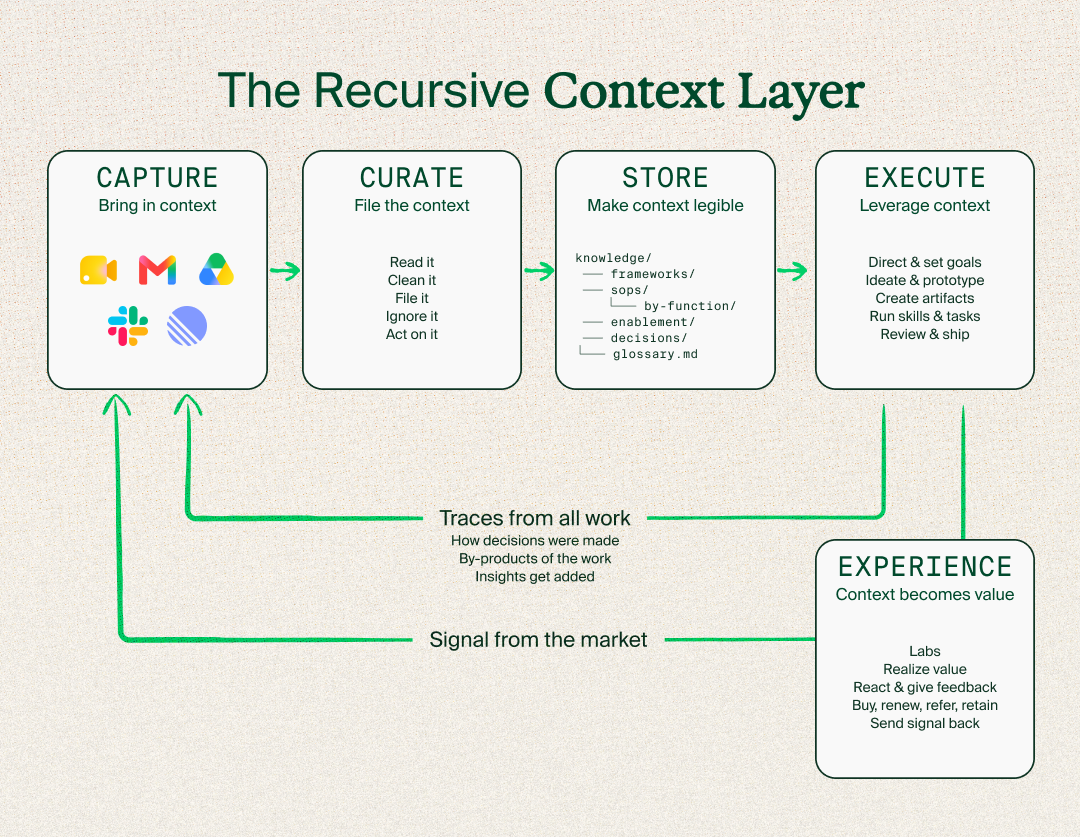
The traces piece is worth double clicking on. Every agentic workflow produces cutting-room-floor decisions and by-products. Things like how a choice got made, what was tried and rejected, what a client said in passing six months ago. Most organizations let that pile up and ignore it.
Capture it instead.
Your company brain learns how good work actually gets made, and starts to encode that knowledge automatically.
Why you can’t shortcut it
The three layers are interdependent. A great context layer doesn't help much if your agents don't have the skills to use it. Skilled agents can't reach their potential without the context to orient them. And neither matters if your people don't know how to manage agents or set them up to succeed.
This is why "just use ChatGPT" doesn't move the needle. It skips two of the three layers entirely. You get the execution without the system, which means you get inconsistent output, no compounding, and no moat.
Building the system takes time. But the curve bends sharply once all three layers are working together.
The one thing to take away
Becoming AI-native is a management decision. Think through the lens of what your agents need to succeed, clear goals, the right skills, the right tools, and real context, and you'll be well ahead of most organizations already.
Plenty of companies have fast. The advantage is that an AI-native company never starts from zero again. It only ever knows more. Speed is the part you can see. Memory is the part that wins.
Put the two side by side and it's brutal. The normal company is sprinting on a treadmill, working harder every quarter just to stay in place, losing knowledge every time someone leaves. The AI-native company is climbing a staircase, every step locked in, every project building on the last. Same effort. Completely different altitude a year later.
The gap between the companies might not look like much today because both companies are still standing roughly in the same spot. But the companies that get this in 2026 are going to look unbeatable by 2028, and the ones still bragging about their ChatGPT subscription won't understand how it happened.
The gap between "uses AI" and "AI-native" is widening every single week. Pick which side you want to be on while you still can.