
Creating Nothing Worth Remembering: The AI Problem Leaders Face Right Now
Every leader is feeling the speed problem. The meaning problem keeps getting pushed to next quarter. Why it's harder than ever to hold both, and how to sprint without losing...

A friend once told me the greatest skill in business is the ability to zoom in and zoom out. I took that advice to heart. Hold the details in one hand, and see the horizon in the other.
I think about that advice constantly right now, because I’ve never seen a moment in all of my working career where both lenses are this blurry at the same time.
If you’re a leader of a company, or a team, or a department - or anything where people are counting on you to know what happens next - you may already feel what I’m about to describe. You may not have words for it yet, but you should be feeling it. A weight that didn’t used to be there. A sense that the playbook you’ve been running for years still works but perhaps for not much longer. And you can’t tell if that feeling is intuition or anxiety. So you keep running the playbook and hoping it’s anxiety.
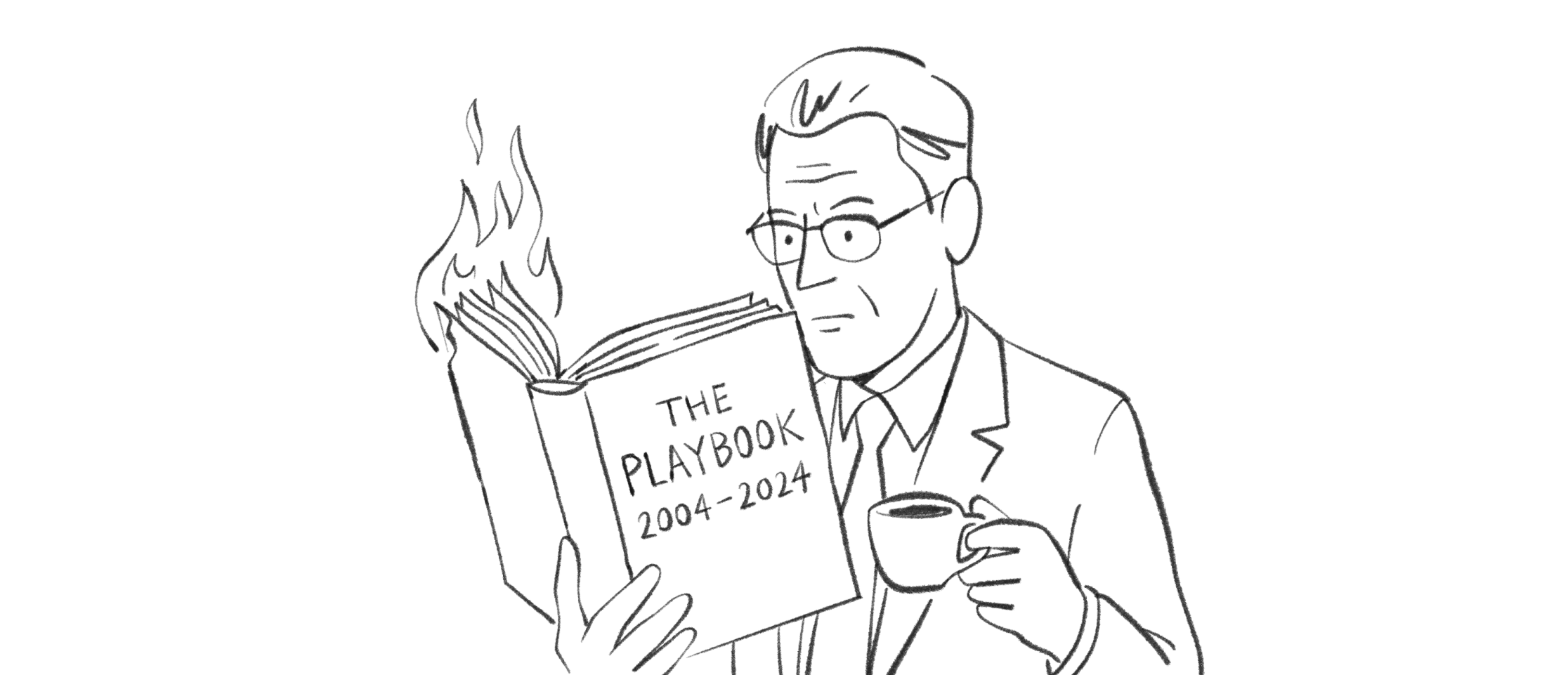
your outdated playbook
This time feels different. I know that’s a dangerous sentence. Every hype cycle produces people who say “this time is different” and most of the time they’re wrong. But something has shifted in the texture of the decisions landing on your desk right now. I want to try to name it.
The TL;DR is this: you have to solve two problems at once, and they pull in opposite directions.
The first problem is speed.
Right now, the most urgent thing on your plate probably isn't your product. That sounds wrong. The product is always supposed to be the most important thing. But it doesn't matter if you know exactly what to build if you move too slow to build it. Your competitor figured out AI workflows three months ago. They're shipping at a pace you can see but can't match. Not because their people are better. Because their system is faster.
So you need to figure out AI. Not as a pilot. Not as a center of excellence that produces a slide deck nobody reads. You need to put it in the hands of the people doing the work and let them move at a speed that would've felt impossible a year ago.
But that's not enough. Because fast tools inside a slow system is its own kind of pain. You can see how fast you could be going while your own processes, your own approval chains, your own org chart holds you back. The org chart you have was designed for a world where humans did every step. That world is ending. If you don't restructure - not just adopt tools, but restructure how decisions flow and how teams are shaped - you'll have a Ferrari engine in a minivan frame. Everyone will feel it. Nobody will say it. Except the best people, who might leave.
fast tools, slow system
And you need to do all of this fast. Because there's a window. The companies that reorganize around AI early get that compounding advantage. The ones that reorganize late don't catch up. They just arrive at the party after the music stopped.
That's the zoom-in problem. It's loud. It's urgent. It's in your face at the beginning of every week.
The second problem is meaning.
This is the one that keeps getting pushed to next quarter.
Let's say you do everything right. You adopt the tools. You restructure the org. You move fast. Now what? What are you building, and why should anyone care?
Because here's what's coming....In twelve months, every company will be able to build useful products fast. You’ve read it in our previous articles - Useful becomes the floor, not the ceiling. If the only thing your product does is solve a problem efficiently, you're competing with every platform AND every AI-powered tool that solves the same problem the same way. And those platforms have more data, more compute, and zero marginal cost. That can’t be the winning strategy. That math doesn't work in your favor and it won't get better.
That's the zoom-out problem. What makes you irreplaceable when everyone has the same tools? What are you building that couldn't have been generated by a prompt? What's the thing about your product - or your company, or your culture - that comes from somewhere deeper than efficiency?
Most leaders I talk to know this matters. They feel it in their gut. But it’s a very real problem when they don’t have time to think about it because the zoom-in problem is screaming at them. The urgent drowns out the important. Speed eats strategy. You solve the production problem and forget to solve the meaning problem. You end up with a fast company that builds nothing worth remembering.
That's the trap. And I think a lot of leaders are in it right now without realizing it.
Moving fast simply isn't enough. You have to move fast AND know where you're running. Hold the microscope and the telescope at the same time. Sprint without losing the plot.
I'll be honest. I don't think most companies are set up for that. The muscle memory is wrong. For twenty years, strategy meant picking a direction and executing against it for three to five years. The direction stayed roughly stable. The execution was the hard part. Now the direction changes every quarter and the execution is getting automated. The entire model is inverted and most orgs are still running the old one.
If you're a leader reading this and you've been feeling like things are harder than they should be — like you're working more and seeing less clarity, not more - I don't think that's a failure of effort. I think you're experiencing what it feels like when the game changes while you're still playing the old one.
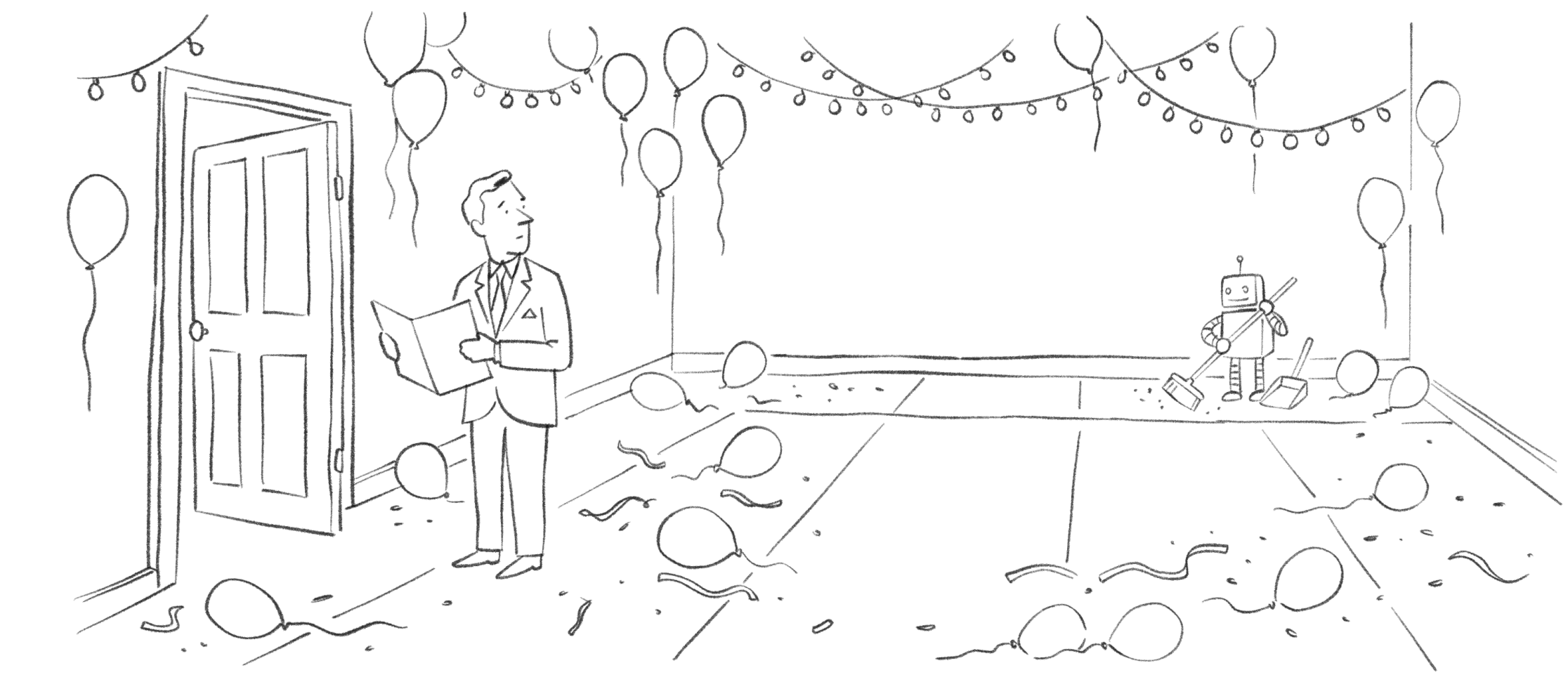
don't arrive when the party's over
The skill now is zoom in, zoom out. Hold both. Don't let the speed problem make you forget the meaning problem. Don't let the meaning problem make you too slow to survive.
You can't just do one. If you only zoom in, you'll be fast and forgettable. If you only zoom out, you'll have a beautiful vision and no way to get there before someone else does.
Both lenses. Same hand. That's the job now. 🫡